-
How many Blind People have to be Hit before the Law is changed in Arizona?
Our Bill in the Arizona state House, HB2064, is dead. It died between committees. A lot of bills for various reasons die in committee. As many times as we called and utterly begged the chair of the Rules Committee to put the bill on his agenda, Chairman of the Rules Committee, Laurin Hendrix, would not put it on the agenda. Because all house bills have to be through committee before March 12th, the bill may still be active, but it is dead.
In order for you to understand how we got to this point, I must lay out a timeline. On May 13th of 2025, I came incredibly close to being hit by a car. The driver had ran a stop sign and came so close that I had to rear back with my cane in hand to keep from getting hit.At that time, I still had a little vision in the center but still legally blind. After I finished crossing the road with my heart racing, I discovered that a Payson, Arizona police officer was crossing. I waived him over. I asked him to go after the car and at least write them a warning for running a stop sign. He smiled, refused to do anything, and said that people make mistakes. I found out later that the woman in the white car that almost hit me was more than likely his wife. In small towns like Payson, everyone knows everyone.
Because of my background in criminal justice, I started researching the state laws in regards to blind people. To my horror, I discovered that there is an antiquated statute, 11-1024, that is somewhat of an umbrella law that covers not letting someone with a guide dog in your business and hitting a blind pedestrian. This statute only charges up to $750 and is only a level 2 misdemeanor.
Every state around Arizona has harsher penalties for hitting a blind or deaf pedestrian. On May 15th, 2025, I started calling and emailing my local representatives for Payson, Arizona. I called legislators Walt Blackman and David Marshall Sr., both of which represent my district, LD7. Legislator Blackman’s administrative assistant got back in touch with me on May 30th and asked if I’d like to talk to Mr. Blackman about updating the statute.
Walt Blackman called me on June 2nd, 2025 and talked to me about what I was looking for and how he could help. We had a productive and friendly conversation. He told me he would work on a proposal and have it to me by the end of the day. During the summer, the House is out of session and most legislators are on vacation during this time.
A few days went by, so I emailed his AA. On 6/12/2025, Mr. Blackman sent me the draft bill. I sent it to my group of blind friends that I was seeing every week whilst at ACBVI in Phoenix. We went over the draft bill and had some suggestions for the legislator.
On August 20th, 2025, Walt and I had another discussion about the bill. He offered to meet us on September 4th, 2025 at the Capitol. When I told the group at ACBVI, they were incredibly happy. Unfortunately, a lot of people in the blind community feel that no one cares about them and no one listens. This meeting was supposed to provide them with a chance to speak to someone in power. Even though Mr. Blackman, like all elected officials work for the people, they are in a position of power given to them by the people.
On the late afternoon of August 28th, 2025, I received an email from legislator Blackman’s AA, stating that he would be out of town the week after the meeting was supposed to happen and would be unable to have a meeting with us on September 4th.
All I could think about after getting that email was all the sad faces and broken hearts of people that thought for once in their lives that someone in power actually cared. It was labor day weekend. No one would answer the phone. In sheer desperation, I called a local radio station, KMOG, in Payson and asked one of the DJ’s if there was anything he could do or if he had another number for Walt. He started getting mad once I told him Walt had canceled a meeting with a group of blind people. He said he would call Walt and let me know.
I still do not know what was said or if he called Mr. Blackman while on the air, but it did get Mr. Blackman’s attention. Within 20 minutes, his AA was on the phone with me asking if I would take his call. He was very upset and angry that I had called Steve at KMOG and told the truth. Either he was confused about the dates or he didn’t think we were important enough to warrant a meeting. After yelling at me for five minutes, he finally calmed down. After I offered to file a FOIA request and play the audio of him saying September 4th, he remembered the date and apologized.
He set the meeting back up for September 4th as originally discussed. We met him in a conference room in the basement of the House building at the Capitol. The group were able to give him suggestions. He was very jovial and kind to everyone. The group was very happy they were able to express their opinions and offer assistance during this process. He told us that he would have us a finished bill in October and could pre-file it early in November for the 2026 House session.
During the month of October, 2025, I kept calling and emailing his assistant asking for an update. After numerous calls and emails, his assistant emailed us the rough rough draft of the bill on November 10th, 2025. The bill was what we asked for. Everyone at the blind center was so happy that we finally had a bill. I made sure everyone knew that we had to wait on Mr. Blackman to submit the bill.
I respectfully kept calling and emailing, pleading with them to submit the bill. I did not want the bill to get lost and never get submitted for the 2026 session. During the second week of December, I called every legislator in the Arizona state House, asking them to please inquire with Mr. Blackman about the bill. On December 9th, 2025, he called me, angry that I had called the other legislators, and told me that he would submit the bill at his time and choosing. I am a fairly well educated American citizen. It is of my extensive understanding that elected officials work for us, right?
I let it go and enjoyed the holidays and was in the process of moving at that time. I didn’t have time to call and inquire. Once the new session started in January, I checked Walt’s bills. To my delightful shock, our vulnerable pedestrian bill was listed and it had a number, HB2064. He had pre-filed it on December 16th of 2025.
The bill was read for the first time on 01/12/26 and was assigned to the judiciary and rules committees. It had its second reading on 01/13/26. The House Judiciary Committee put it on their agenda and voted 8 to 1(8 Republicans voted for it and 1 Democratic voted against it.) to pass it. The next hurdle was the Rules Committee. We waited a few weeks. It was never put on the agenda. I had a large group of blind and sighted people call and plead with the Chairman, Laurin Hendrix, to put the bill on the agenda. I emailed legislator Walt Blackman, the sponsor of the bill, several times, pleading for help or suggestions. I called countless times and left messages. Nothing.
To his credit, Walt submitted the bill. He had some great ideas and did what he said to a point. I cannot say whether he submitted the bill to shut me up or he had genuine interest in updating the law regarding blind and vulnerable pedestrians. Did the NFB, National Federation of the Blind, get involved and stop it? I don’t have an answer as of yet. I will find out.
Why would the NFB stop this bill? This bill protects vulnerable pedestrians, including the blind, and fills a gap in the law. At present, there is no restitution required if you hit a blind person. If you hit my guide dog, for example, there is no protections for the guide dog. There is no restitution. There is no education requirements with DMV drivers license testing. This bill would fix all of that and update the penalties, if we are hit by a car. They would stop it, because I, a blind man, and a group of blind friends worked on this bill, not the NFB. They can’t take credit for it, thus they would do everything in their power to kill it. They may have. I do not know. But, if the bill pops up next session with the NFB sponsoring it, we will know.
Mr. Blackman may have felt like this bill would not give him a big enough PR boost for his upcoming election in November. I don’t know. I think at some level, he does care. He offered a lot of great ideas, such as the education requirement, that I didn’t even think about in the beginning. At the end of the day, he let this bill die. When blind people are hit almost daily by negligent drivers, this is inexcusable. The bill was not allowed to get to the Arizona State House for a floor vote. The democratic process was not completed.
These state politicians do favors all the time. I used to work for a political think tank years ago. Mr. Blackman is the Chairman of the government committee, thus he sets the agenda for that committee. Mr. Hendrix might have a bill that he wants on the agenda. All Walt had to do was ask Mr. Hendrix to put HB2064 on the agenda and do each other a favor, but alas, he did not.
Now we have to wait another year. How many more vulnerable pedestrians have to get injured or killed before something is done? Every time a blind person steps off the curb, we are literally walking by faith alone. We hope that the drivers stop as they should, but there is no guarantee.
During December of last year, the wife and I moved to Oklahoma. The penalty for hitting a blind pedestrian here is $100, a joke. Thus, I have to start the process here soon. I hope that someone, a blind person, stays on the politicians in Arizona and gets this bill passed next year. Who knows, I could be in LD7, Payson and Show Low are, later this year, making sure every voter knows what happened.
I will include a copy of the bill below. What are your thoughts? -
Life’s Blind Illumination
If you’ve stumbled upon this little corner of the internet, thank you for being here. I’m just a guy who’s spent most of his life chasing light through a lens, and lately, that light has started to fade in ways I never quite imagined. This post isn’t meant to be a pity party or a grand manifesto, I’m no expert on resilience, just someone muddling through with a heart full of gratitude and a camera bag that’s gotten a bit lighter over the months. But writing has always been a quiet companion to my photography, a way to make sense of the frames I capture (or, these days, the ones I remember). So, with a deep breath and a humble nod to God, here’s where my story sits right now.
It started with a simple video. Yesterday, I hit record on my phone for Instagram, a raw, rambling clip from the heart about the sting of going blind and what that means for the photographs I’ve loved making. I poured out the ache of knowing I can’t nail those perfect compositions or exposures anymore, the kind that come from years of squinting at a scene with my one good eye and just knowing. Film has its own personality, doesn’t it? Fomapan with its moody shadows and tight latitude, Kentmere offering a bit more forgiveness in the highlights. Details like that live in my head, etched from decades of trial and error. But my eyes? They’ve decided to bow out early. Five doctors, the state of Arizona, and the U.S. government all agree: I’m beyond legally blind, teetering on the edge of total darkness. I wake up each morning bracing for the day it all goes black.
About two months back, the warning signs ramped up. Closing my eyes brought flashes of random colors and lights, like a faulty projector spinning out of control. That sliver of vision I had left, five degrees on a good day, turned blurry, turning the world into soft-edged blobs. I laughed it off in an article I wrote, calling everyone a “blob” because, well, humor’s been my shield against the heavy stuff. But reality doesn’t stay polite for long.
One afternoon, I picked up one of my trusty SLR film cameras, the kind that’s felt like an extension of my hand for years. I tried to focus. Couldn’t. The viewfinder swam into nonsense. Composition? Forget it—that narrow tunnel of sight wasn’t enough to frame a thought.
I found myself on a park bench that day, head in hands, weeping for what felt like hours. Self-pity wrapped around me like fog, thick and unyielding. It was the first time I’d let the full weight of it crash down. I haven’t lifted a camera to shoot since, not one single frame. In the haze of those weeks, I started selling off pieces of my collection, each transaction a quiet goodbye to the tools that shaped my world. All that’s left now are my beloved folding cameras, with their tactile folds and whispers of history, and two SLRs I just can’t part with. They’re like old friends I can’t bear to lose, even if they sit gathering dust.
Looking back, I’ve been dancing with this shadow for longer than I care to admit. As a kid, doctors warned I’d lose my sight in adolescence. It didn’t happen, praise God for that grace, and maybe that’s why I’ve poured everything into photography. Forty years as a hobbyist, twenty as a professional. Every click was a prayer, a moment stolen from time.
Through breakups and breakthroughs, lean years and laughter, that passion kept me steady. It wasn’t about fame or perfection; it was joy, pure and simple. Losing it? It’s like misplacing a limb. For months, I’ve wandered aimlessly, future a foggy outline. But I’m not alone in the drift, Jesus has been my anchor, my wife my soft place to land, and our three goofy pups? They’re the daily reminder that wagging tails don’t need perfect vision.
Yesterday morning, something shifted. I woke with a spark, not a wildfire, just a gentle glow. Determination, I suppose you’d call it. I dug into a folder of unreleased shots from a May trip, landscapes that still make my heart hum even if I can’t see them sharply anymore. I posted a few, tentative steps back into sharing. I didn’t head out to shoot, but the thought lingered, whispering maybe. The truth is, I hold myself to impossible standards, flawless light, impeccable lines that I wouldn’t dream of expecting from anyone else. It’s a humble brag wrapped in humility: I’ve been blessed with skill, but pride can be a sneaky thief. How do I create without chasing ghosts of what was?
This road to blindness? I wouldn’t wish it on my worst enemy. It’s lonely, riddled with “what ifs” that echo in the quiet hours. But here’s the quiet miracle: it led me to the blind center in Phoenix. Walking through those doors flipped the script. Suddenly, it wasn’t the end of my story but a pivot to a new chapter. I’ve met folks who get it, the raw grief, the stubborn spark. Some love photography as fiercely as I do, swapping tips on adaptive gear like it’s the most natural conversation. Together, we’ve sparked an advocacy group here in Arizona, a loose band of encouragers lifting each other up. No heroes among us, just people saying, “Hey, you’ve got this—one step at a time.”
Life’s gone tactile now, and there’s a strange beauty in that. Braille bumps under my fingers, keyboard clicks like Morse code for my thoughts. Cameras with dials and buttons? They’re gold, things I can map in my mind, muscle memory overriding the dark. Tomorrow, I’m pulling out my Minolta Maxxum, that autofocus wonder with its forgiving heart. I’ll give it a go, no pressure, just curiosity.
Scanning the negatives afterward will be a puzzle, details lost to me, but that’s the thrill, isn’t it? An adventure in trust, handing the reveal over to the machine and whatever magic it uncovers.
I love this part, if I’m honest, the relearning. Figuring out angles by sound and feel, composing by instinct honed over lifetimes. Lights? Who needs ’em? I navigate just fine in the pitch black, a skill that’s equal parts survival and secret superpower. It’s all a gift, wrapped in loss, reminding me that sight was never the whole picture.
If you’re reading this and facing your own storm—big or small—know this: it’s okay to sit on that bench for a while. But don’t stay there forever. Reach for the hand extended, whether it’s a friend’s, a stranger’s at a support group, or the steady one from above. I’m still figuring it out, one humble frame at a time. Life? It’s good. Messy, blurred at the edges, but profoundly good.
Thanks for letting me share. Drop a note if this resonates. I’m all ears (and heart). Until next time, keep chasing what lights you up, however dim the path.
With quiet thanks,
Jefferson Davis

-
Zeiss Ikon Contessa
If you know me at all, you probably know that I love old Zeiss Ikon cameras. They are a bear to work on and a bit fiddly at times, but all old cameras have their quirks that make them unique and endearing. The camera I am reviewing today is the later Contessa, the compact rangefinder that, although it is heavy by today’s standards, it is compact for its time, embodying a blend of innovation and classic design. These were developed in the early sixties with selenium light cells for light meters, a cutting-edge technology at the time that highlighted the ingenuity of camera engineering.
Over the years, I have acquired a few of these with working light meters and a few that didn’t work at all, and it’s fascinating to see how the functionality can vary so significantly across different models. It is very rare that they are accurate, as the passage of time often takes its toll on these delicate mechanisms. I would not recommend you rely on that alone, especially with a color film that requires accuracy; after all, achieving the perfect shot is often about timing. Black and white film, what I use the majority of the time, has a lot more exposure latitude, allowing for a bit more creative freedom in the developing process.
This particular model is accurate within a stop some days and not accurate at all on other outings, creating a sense of unpredictability reminiscent of film photography’s charm. You can sometimes revitalize these old light meters by cleaning the contacts, a rewarding endeavor for those who enjoy tinkering; each restoration feels like breathing new life into a forgotten piece of history. Cleaning these old cameras is good to do, regardless of the chance of rescuing the light meter or not, as it enhances their functionality and preserves their beauty. The main reason for this post is to talk about the amazing little lens they put in these little cameras. It has a Carl Zeiss Tessar 50mm f/2.8 lens that is sharp and takes stunning photographs, rendering details in a way that often surpasses modern lenses. As stated, I usually use black and white film, but due to the coatings on the lens, you can use any color film, allowing for vibrant and rich imagery that stands the test of time.
This particular model has accurate shutter times, smooth aperture operation, and buttery focus, creating an exhilarating shooting experience that brings joy to both seasoned photographers and novices alike. These cameras are at such a great price point, making them an accessible option for anyone interested in exploring the world of rangefinder photography. If you want to try a rangefinder before shelling out thousands of dollars on a Leica, buy one of these cameras; the value they offer is truly exceptional. You will not be disappointed in the quality of the lens and its sharpness, which can capture faint details even in less-than-ideal lighting conditions. Due to its coatings, it does provide a lot of contrast as well, delivering images with depth that draw the viewer in.
I am selling this one on eBay, but I would recommend it whether I am selling one or not; my admiration for these cameras goes beyond mere transactions. If you have any questions about the camera, leave me a comment. Or, maybe you have one handed down through the generations, each with its own stories and memories. Tell me your story, as I am always excited to hear about fellow enthusiasts who understand the passion that surrounds these wonderful machines. -
Living in the Tonto National Forest in the High Desert
In May of this year, I wrote about moving to Arizona; in fact, it was my last post. We were so busy with selling the house and the chaos that ensued and finding a place to live out here that I didn’t update the blog. We’ve been living in the Tonto National Forest for almost two months. As you might imagine, moving across the country is an arduous journey and costly.
We are still unpacking and getting life sorted out. I transferred out here and then started a new job in late August. Life has been hectic, but we are loving it. One of the major reasons we chose Arizona, other than the fact that Deana is from this great state, was its stunning natural beauty, which has offered us endless opportunities for exploration and adventure. The vast landscapes, with their unique rock formations and diverse ecosystems, have become our new playground. Each weekend, we try to set off on new adventures. The local attractions are truly spectacular, and we rarely find ourselves bored with so much to see and do.
I tell people that it is a lot like the mountainous area of South Carolina. It is a more arid climate, of course, the flora and fauna are different, but the people are a lot like they are at home. We live in a small tourist town that more than doubles in size during the summer. The ponderosa pines and mesquite trees sing with glee and give off a glorious scent. The community here is vibrant and welcoming, and we’ve already made a number of friends who have introduced us to local customs and hidden gems that we might have otherwise missed. We’ve also participated in local festivals and farmers’ markets, where we’ve sampled delicious regional dishes and handmade crafts that showcase the talent and creativity of the local artisans.
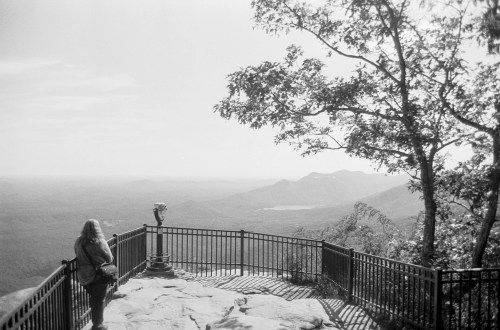
The Mogollon Rim is one of the most breathtakingly beautiful places I have ever seen in my six decades on this earth. On a particularly wet Sunday afternoon a few weeks ago, we drove up to the top of the rim, or at least as far as we could get on pavement, and looked out over all the Ponderosa pines covering the Mazatzal mountains. As we arrived at the lookout, clouds rolled in below us, offering a heavenly vista of the world below, so serene and picturesque. This experience alone made all the challenges and hardships of our move worthwhile. The tranquility of the forest, coupled with the majesty of the towering cliffs, makes this place a true sanctuary.