-
Monday Jaunts Through Norman: Coffee, Chaos, and the Senses That Guide Me
Mondays have become my favorite kind of reset. While the rest of the world seems to groan its way back into the workweek, I lace up my shoes and head out for a long, slow walk around Norman, Oklahoma. There’s something deeply comforting about the familiar rhythm of these days: the aroma of fresh coffee, the distant buzz of college students stressing over exams, and the constant percussion of construction echoing through the streets.
This morning started, as so many good ones do, at Yellow Dog Coffee. I settled in with not one, but several cups, letting the rich, warm brew wake up my senses and my spirit. The place has that perfect small town coffee shop energy, friendly chatter, the hiss of the espresso machine, and just enough background noise to feel alive without being overwhelming. By the time my cousin arrived, I was properly caffeinated and ready for our weekly adventure.
He’s a young man, full of energy and in much better shape than I am these days. We set off together, stopping every so often so I could snap a few photographs along the way. I say “snap,” but for me, photography is less about perfect composition and more about capturing moments I want to remember later, textures, contrasts, and the way light feels even when my eyes don’t cooperate the way they used to. He never complains about the pauses. In fact, I sometimes wonder if he’s deliberately slowing his pace to match mine. Whether it’s kindness or just good patience, I’m grateful for it. These walks mean more to me than he probably realizes.
It was a beautiful afternoon in Norman, bright, breezy, and just windy enough to keep things interesting. The sky stretched wide and blue overhead, interrupted only by a handful of sparse clouds and the occasional crisp white contrail slicing across it. As someone who is legally blind and severely visually impaired, I’ve learned to lean heavily on my other senses during these outings. Sight might be limited, but the world still offers itself to me in vivid layers of sound, smell, and touch.
We’d pass by a tall building and suddenly I’d catch the sweet, delicate perfume of spring blossoms riding on the wind. A few steps later, the scent would shift dramatically to the sharp, unmistakable tang of urine lingering in a shadowed corner, or the heavy, skunk aroma drifting from one of the local weed dispensaries. Norman is full of these contrasts. One moment you’re breathing in the promise of new growth and Southern charm; the next, you’re reminded that every city has its raw, unfiltered edges.
And that’s okay. I love this town precisely because it can hold both truths at once. Norman is genuinely beautiful, with its friendly people, tree-lined streets, and that unmistakable college town energy that keeps it young and vibrant. The community here is warm and welcoming in a way that still surprises me sometimes. But I won’t shy away from the truth either; the good, the messy, and everything in between. That honesty, I think, is part of what makes this place feel like home.
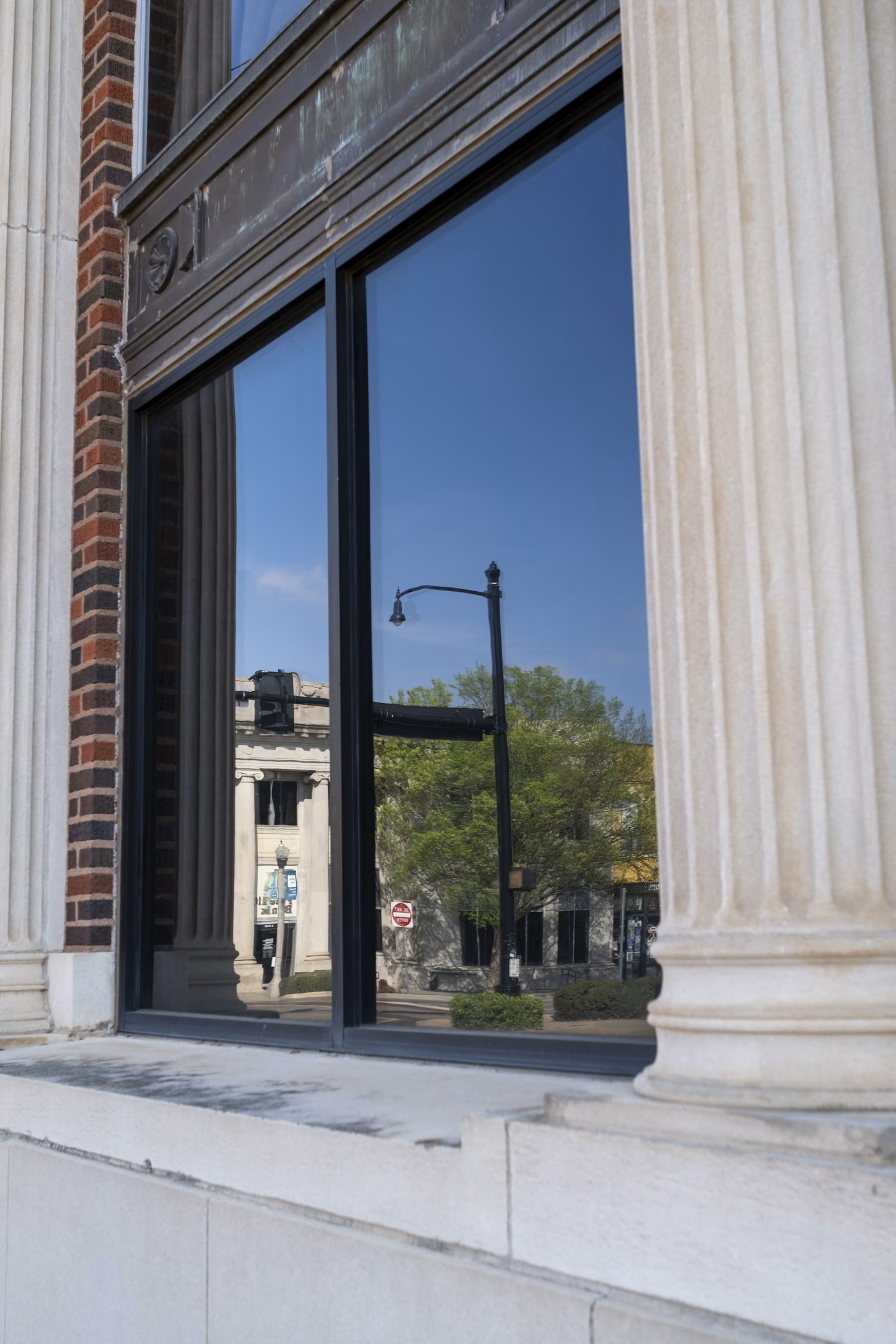
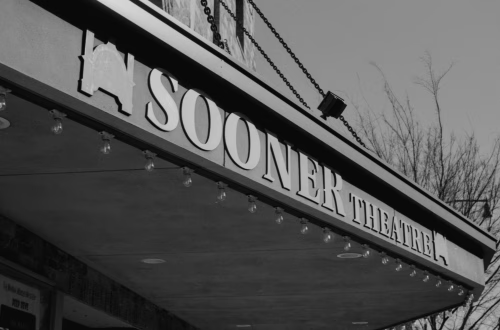
Tonight I don’t have many words left in me. The walk was long, the coffee strong, and the company excellent. Instead of more storytelling, I’ll leave you with some of the photographs I took during today’s jaunt. They may not capture every scent or sound, but I hope they give you a glimpse of the Norman I walked through this Monday.


-
Why I Chose the Fujifilm X-T4 for My Digital Photography
Over the past few weeks, I’ve been writing about the rising cost of film photography, and unfortunately, the trend hasn’t slowed down. With global instability, tariffs, silver prices, and persistent inflation, film prices continue to climb. Film photography is drifting into the territory of a luxury hobby. That’s a difficult reality to accept, especially for those of us who have relied on it as a primary creative outlet.
I don’t want photography, especially something as timeless and expressive as film, to become inaccessible. But practicality has a way of forcing decisions. For me, that meant looking for an alternative.
Some of you may remember that I previously owned a Sony A7cII. It was, in many ways, an incredible camera, compact, full-frame, and packed with modern technology. I genuinely loved using it. But after our move, I found myself back in the market, searching for something more affordable yet still capable. This time, however, I wanted something different, something more tactile, more physical in its design and operation.
My vision plays a major role in how I interact with cameras. I have about five degrees of vision in one eye and none in the other. On top of that, the vision I do have is around 20/200. That places me well within the definition of legal blindness in the United States, both in terms of acuity and visual field. In simple terms, I’m working with very limited visual information.
Because of that, the way a camera feels in my hands matters just as much as what it can do technically. Buttons, dials, and physical controls aren’t just aesthetic preferences, they’re essential. I need to be able to operate a camera through memory and touch as much as sight.
When I last searched for a camera, I came across Fujifilm’s X-T series but ultimately chose Sony for its compatibility with my collection of Minolta Maxxum lenses. This time, I revisited that decision.
I started researching the Fujifilm X-T lineup, the X-T3, X-T4 and X-T5. The X-T5, while impressive with its 40-megapixel sensor, is still relatively new and priced accordingly. The X-T3, on the other hand, is a solid performer but beginning to show its age, having been released back in 2018.
That left the X-T4.
The X-T4 strikes a balance that’s hard to ignore. It features a 26-megapixel sensor, excellent build quality, and meaningful upgrades like improved autofocus with eye tracking and a faster burst rate. More importantly, it retains the tactile design philosophy that Fujifilm is known for; dedicated dials, physical controls, and a shooting experience that feels deliberate and intuitive.
After some patient searching, I found a used X-T4 with a low shutter count for roughly half the price I had paid for my Sony. It felt like one of those rare moments where everything lines up perfectly; a professional level camera at a consumer level price.
I paired it with a few inexpensive adapters for M42, Pentax K, and Minolta mounts so I could continue using my vintage lenses. Even with its APS-C sensor, the image quality is outstanding, more than enough for my needs and far beyond what the price might suggest.
One aspect I didn’t expect to dive into was Fujifilm’s film simulation recipes. What started as curiosity quickly turned into a bit of a rabbit hole. I’ve since set up several custom recipes tailored to my preferences, and they’ve become a core part of how I shoot.
Regardless of whether I’m using film or digital, I always shoot in black and white. With my level of vision, contrast isn’t just an artistic choice, it’s a necessity. Color, while beautiful, is noise to me. It distracts more than it helps.
Contrast, on the other hand, defines the world.
I use a cane to navigate my surroundings, but when it comes to photography, contrast is what guides me. Within that narrow five-degree window of vision, everything is blurred. Without strong separation between light and dark, the scene collapses into an indistinct mass. But when contrast is present, when shadows and highlights carve out shapes, I can see. Not clearly, but meaningfully.
The X-T4 fits into that process beautifully. It’s a tool, first and foremost. I don’t pretend to use it to its full technical potential, but I use it often, and I use it with intention.
Like many visually impaired people, I rely heavily on memory. I memorize environments, layouts, and patterns. Photography is no different. I memorize my camera settings and the physical positions of the dials. I know how far to turn a knob, which direction adjusts what, and how each change will affect the image.
If I set my ISO to 160 and my shutter speed to 1/125 of a second, I can rely on muscle memory to adjust the aperture accordingly. That part becomes second nature.
What matters is the result, the ability to capture something from the world as I experience it.
The Fujifilm X-T4 has proven to be an incredible companion in that effort. It’s not just about specifications or features; it’s about how the camera fits into my way of seeing, or, more accurately, my way of interpreting what little I can see.
I’ll be putting together a long-term review in a few months after I’ve spent more time with it. For now, I can say that it has allowed me to keep creating at a time when film photography feels increasingly out of reach.
And that, more than anything, makes it worth it.
Below, I’ll be sharing some sample images from my time with the camera so far.


-
My ‘Gotcha’ Moment: Tech and Blindness Misunderstandings
Mondays with decent weather mean one thing: a walk to my favorite local spot, BeanStalk Coffee on Main Street here in Norman, Oklahoma. I cut through the brisk wind, navigate the crosswalks with my cane tapping the way, and arrive around 8 AM feeling accomplished.
I order my usual drip coffee (the barista kindly brews a fresh batch when it’s low), grab it when it’s ready, and head outside to a bench a few hundred feet away. Coffee in one hand, I settle in, pull out my iPhone, and start scrolling through Instagram the way I always do.
That’s when it happened. A guy approaches, big smile on his face, and hits me with: “I caught ya!”
I laugh. What else do you do? Still grinning like he’s uncovered some big secret, he points out my white cane and says something like, “You’re blind… but you’re looking at your phone”.
Cue my internal laughter. I smiled back and asked, “Can you see the hearing aids in my ears?”
He said, yes.
Then I explained: “I’m using VoiceOver, the built-in screen reader on my iPhone. It reads everything out loud, and since my hearing aids are Bluetooth, the audio pipes straight into my ears. No need to see the screen at all.”
His jaw dropped. He was genuinely blown away. He apologized right away, called me a “high-tech blind dude,” and we chatted for a minute before he walked off, probably a little wiser.
This isn’t the first time. Over the past year since I started using my cane full-time, I’ve had plenty of these “gotcha” moments. People spot the cane, see me on my phone (or “looking” at it), and assume I’m faking it for attention or sympathy. It’s frustrating, but honestly. It makes me laugh more than anything now. Because the reality is so different from what most folks imagine.
Blindness is a spectrum, and tech has changed everything. VoiceOver (and similar tools like TalkBack on Android) lets us browse social media, text, read emails, check the weather, navigate maps, shop online, you name it. The phone speaks to us, we gesture or use commands to interact, and Bluetooth hearing aids or bone-conduction headphones make it seamless and private. No squinting, no magnification needed if you don’t have usable vision. It’s not magic; it’s just smart design from Apple and others that’s been around for years.
Yet the myth persists: “If they’re blind, they can’t use a phone.” Or worse: “They must be faking because they’re looking at the screen.” I’ve seen it online as well, photos of cane users on phones sparking comment wars, people confidently declaring fraud. It hurts because it comes from ignorance, not malice most of the time. And it makes some of us self-conscious about pulling out our devices in public, like we’re doing something wrong.
But we’re not. Scrolling Instagram on a bench with a coffee? That’s just being human. Checking the time, replying to a message from a friend, reading a blog post like this one. It’s independence, not deception.
To my fellow blind and low-vision folks: Don’t let these encounters dim your day. Keep using your tech proudly. It’s not a contradiction; it’s progress. If someone says something like above, you don’t owe them a full demo, but if you’re in the mood, a quick, calm explanation can plant a seed. Like I did that day: mention VoiceOver, point them to Settings > Accessibility > VoiceOver on their own phone, and watch their perspective shift.
And to the sighted world reading this: Blindness doesn’t look one way. We don’t all wear dark glasses 24/7, although I do a lot of the time, stare blankly ahead, or avoid tech. Many of us have some residual vision, or we use tools that let us engage with the world on our terms. The next time you see someone with a cane on their phone, resist the urge for a “gotcha.” Curiosity is fine. Ask if you’re genuinely interested. But assumptions? They just make things harder for everyone.
Patience really is key in our world. The sighted world often doesn’t get it, and that’s okay, they haven’t lived it. But we can bridge that gap by educating when we have the energy, supporting each other, and refusing to shrink ourselves to fit outdated stereotypes.
So, I got “busted” Monday. But really? I was just living my life, coffee, cane, bench, and a phone that talks to me. And that’s not faking anything. That’s thriving.
What’s your story? Have you had a similar “gotcha” moment? Drop it in the comments. I’d love to hear your stories. We’re all in this together.
Stay high-tech, stay patient, and keep tapping those routes.
Jefferson (the high-tech blind dude) 🇺🇲