-
Every Dot Counts: Contracted Braille (UEB Grade 2) Explained
As a blind photographer, I spend a lot of time thinking about how we take in the world. For me, reading is done with my fingertips. Braille is a big part of my daily life, so I made this short video for anyone learning it, and for the parents and teachers helping them. Here’s what the video covers.
It all starts with one cell
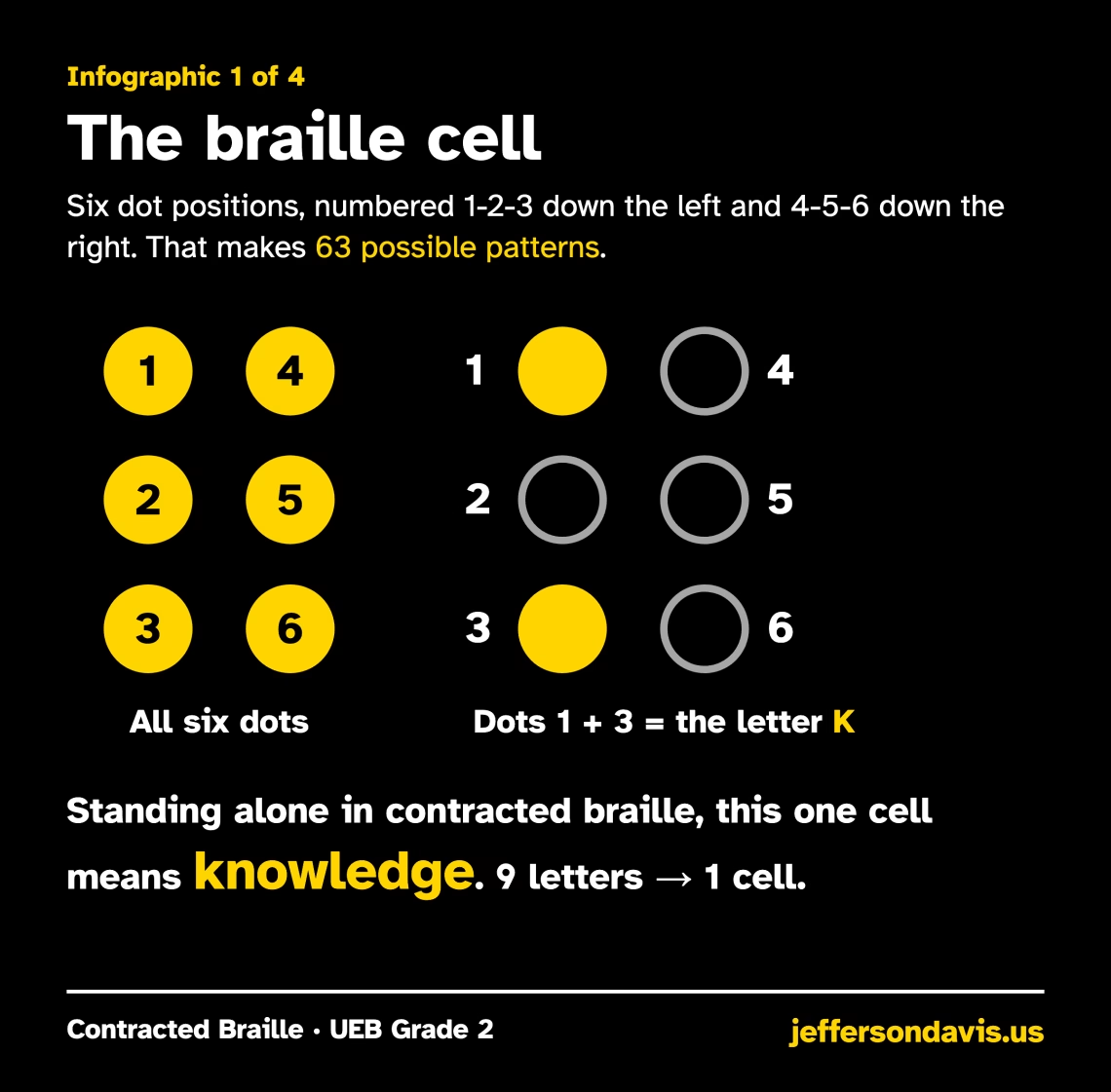
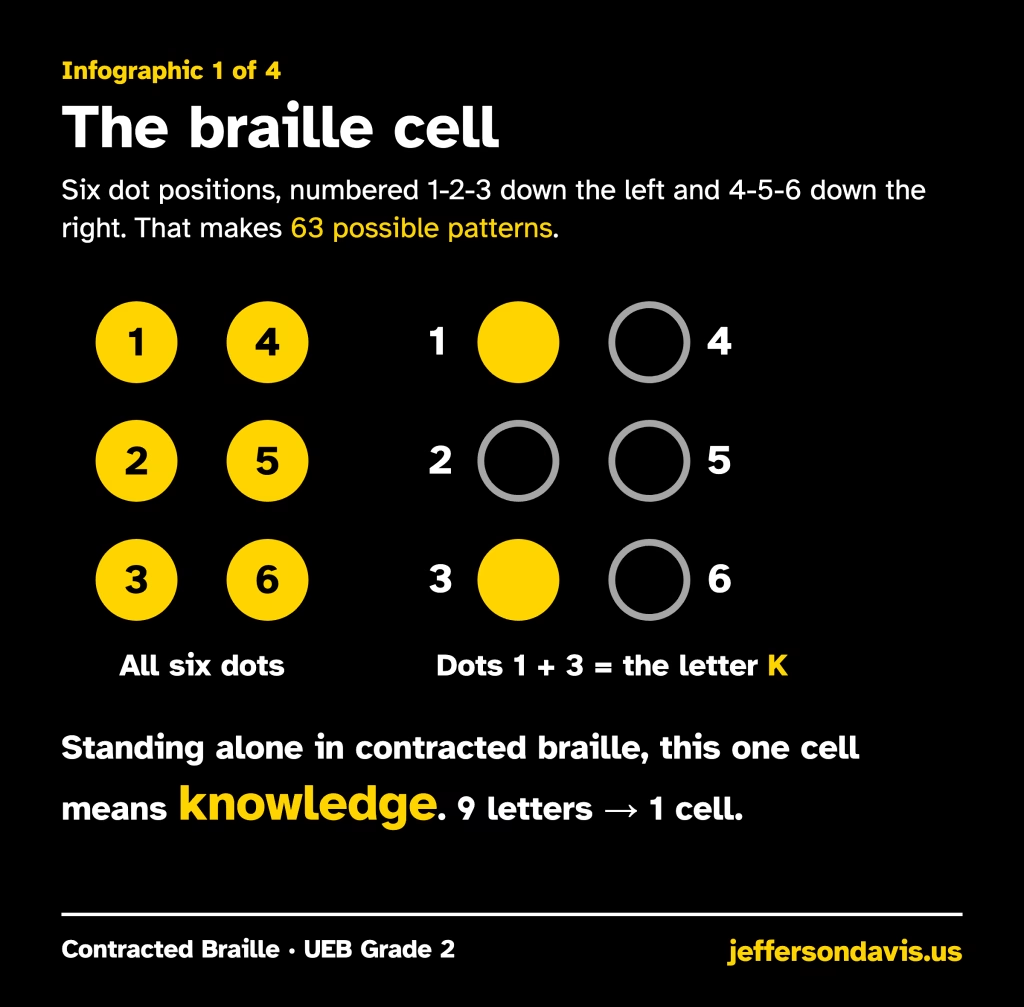
Every braille character is built from a single cell of six dot positions. Dots 1, 2 and 3 run down the left side, and dots 4, 5 and 6 run down the right. That gives just 63 possible patterns. Raise dots 1 and 3 and you have the letter K. In contracted braille, that same cell standing alone means a whole word: “knowledge.”
Why contract?
Uncontracted braille spells out every letter. Contracted braille, officially Unified English Braille (UEB) Grade 2, uses about 180 contractions to save space and make reading faster. Most books, signs and documents in the U.S. use it.
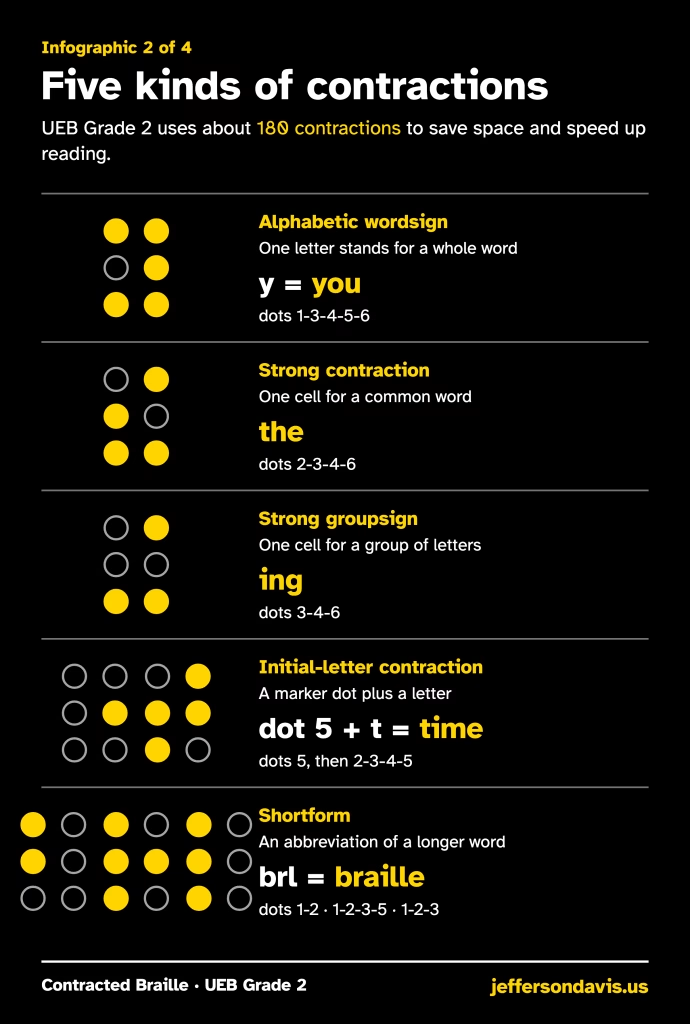
Here are the main kinds you’ll meet:
- Alphabetic wordsigns: one letter stands for a word, like Y for “you.”
- Strong contractions and groupsigns: one cell for “the,” “and,” “for,” or “ing.”
- Initial-letter contractions: a marker dot plus a letter. Dot 5, then T, makes “time.”
- Shortforms: abbreviations, like B-R-L for “braille.”
What it adds up to
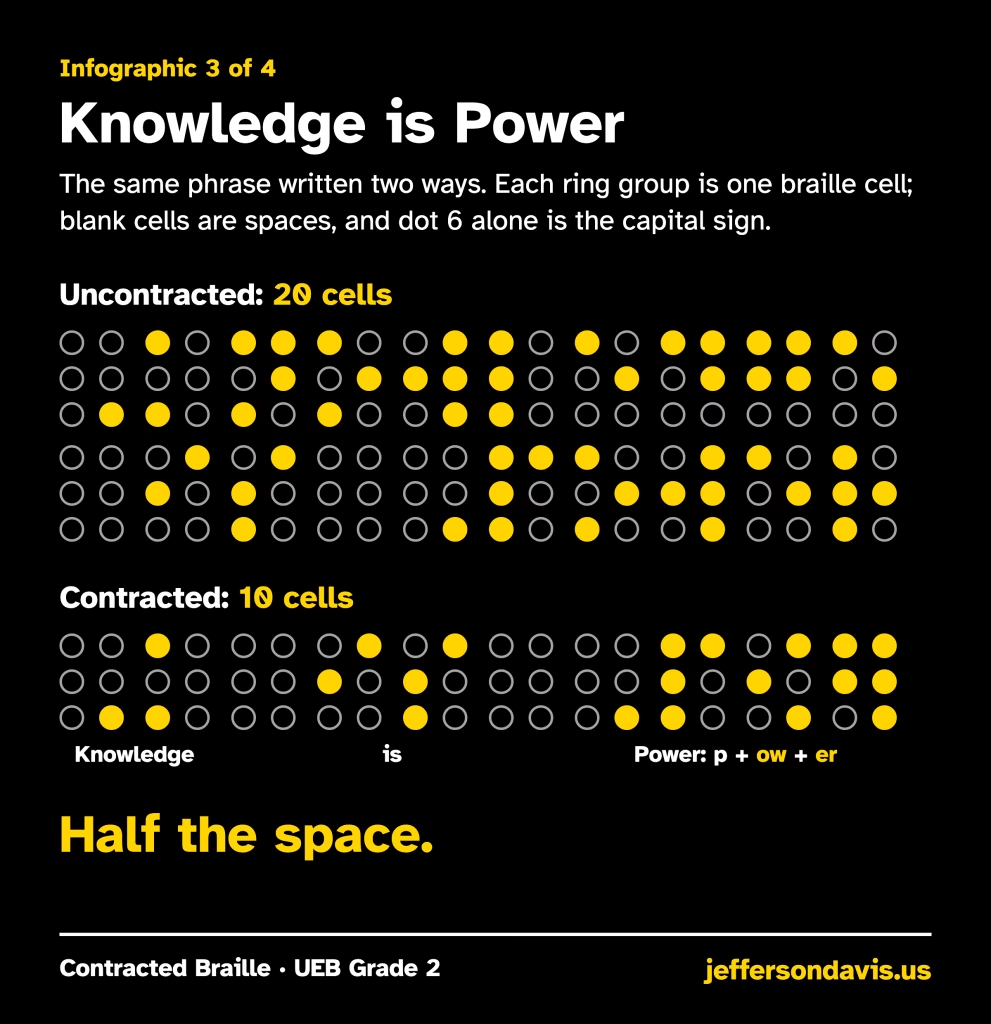
Take the phrase “Knowledge is Power.” Uncontracted, it takes 20 cells. Contracted, it takes just 10. Half the space, and a lot less ground for your fingers to cover.
The switch to UEB
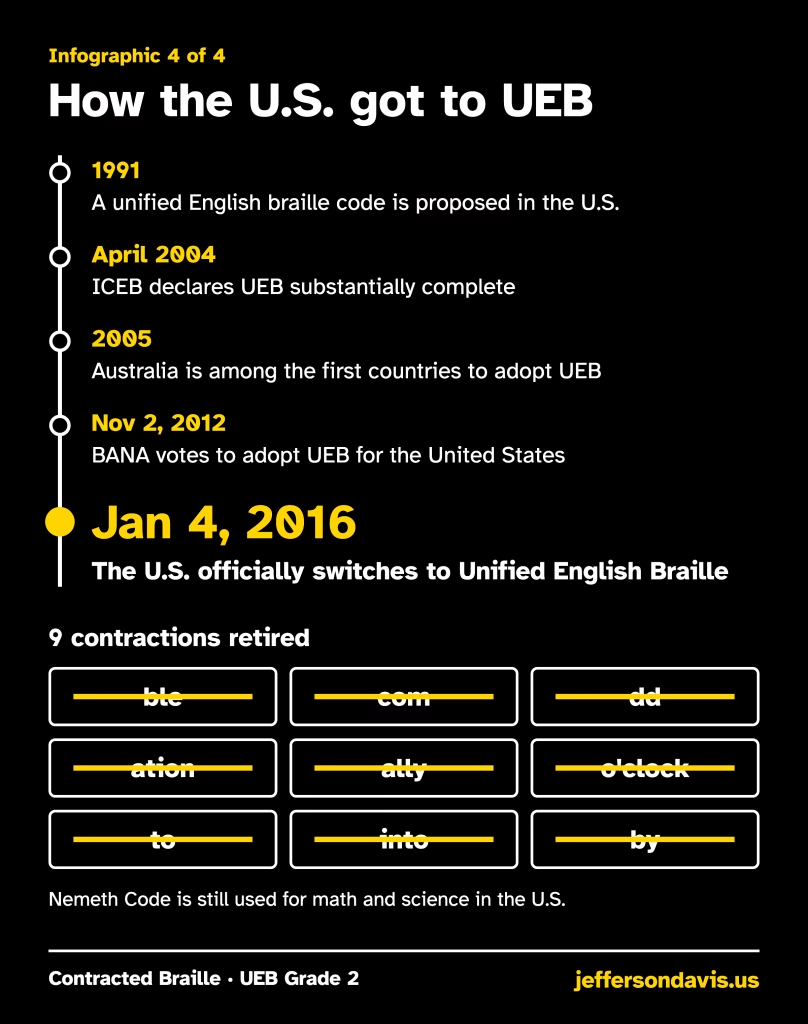
On January 4, 2016 (World Braille Day, Louis Braille’s birthday), the U.S. officially switched to Unified English Braille, the code shared across the English-speaking world. Nine older contractions were retired along the way, and Nemeth Code is still used for math and science.
Keep practicing
If you’re learning contracted braille, go one family of contractions at a time. If you’re a parent or teacher, share the infographics: each one is high-contrast and easy to print. Every dot counts. I will be making an in depth series soon.