-
A Shot in the Dark: Still Chasing Light as a Blind Photographer
Hi, I’m Jefferson Davis, I’m a photographer. It still feels a little absurd saying that out loud sometimes, like confessing a quirky habit at an awkward support group meeting. “Hi, my name is Jefferson, and I’m a blind guy who insists on taking pictures.” But here I am, more than five decades into this wild ride on planet Earth, still hauling cameras around and clicking shutters, even as my vision fades.
It all started way back when I was just one day old. I contracted spinal meningitis in the hospital, a brutal infection that nearly ended my story before it really began. I survived, but the damage was done. It triggered Septo-Optic Dysplasia, a condition that destroyed my left eye in infancy and set off a slow, relentless optic atrophy in my right. Over the years, that right eye has dwindled to about five degrees of usable vision, a tiny peephole into the world, and nothing at all in the left. It’s progressive, irreversible, and one day, likely soon, that small window will close completely. But here’s the honest truth: I’m grateful for the sliver I still have. It lets me glimpse shapes, contrasts, and colors in a way that keeps me tethered to the visual world I’ve loved for so long.
Molly Burke, the advocate and podcaster who’s built a platform around her own blindness, put it perfectly in a recent discussion (paraphrasing from memory): the physical challenges of not seeing are tough, but the social side of blindness, the stares, the assumptions, the isolation, is often the real gut punch. I couldn’t agree more. The cane, the fumbling, the daily adaptations? Those are hurdles I can navigate. It’s the way the world sometimes reacts that stings the deepest.
I still vividly remember my first few trips to the local coffee shop after my vision loss became obvious and I had to use the white cane. I’d walk in with my white cane tapping ahead, and the entire room would fall silent. Conversations halted mid-sentence. I could feel the eyes locking onto me, the unspoken questions hanging in the air: “What’s wrong with him?” “Is he really blind?” “Why is he even here?” The awkwardness was suffocating. It took weeks before the regulars adjusted. Eventually, the stares turned to nods, then smiles, then jokes. We started chatting about the weather, the latest news, or how strong the brew was that day. That shift felt like a small victory. But getting there required me to push through the discomfort, to show up anyway.
These days, the white cane is practically an extension of my arm. I don’t flinch when people stare or whisper. Until I receive a guide dog (and yes, I’ve had plenty of well-meaning folks ask when that’s happening), the cane is non-negotiable for safe, independent mobility. In the blind community, there’s a quiet understanding that guide dogs often carry less stigma. They’re seen as “heroic” or “inspirational,” while the cane can still evoke pity or confusion. But I refuse to let outdated attitudes dictate my choices. I go where I want, when I want, cane in hand, no apologies.
Now, to the part that really baffles people: I’m blind, and I still photograph. When I sling an old film camera over my shoulder, I can practically hear the mental gears grinding in onlookers heads. “Wait… he’s blind. Why is he taking pictures? How does that even work?” I’ve been interrupted mid-shot more times than I can count, strangers stepping right up, genuinely puzzled or sometimes skeptical, asking exactly that.
The answer is straightforward, at least to me. I’ve been making photographs for over 40 years. Some of it was casual fun, some professional gigs, but all of it rooted in a deep love for capturing moments. Losing most of my sight didn’t erase that passion; it just changed how I pursue it. Think about it this way: if you’d spent decades playing golf, perfecting your swing, chasing birdies on the green, dand then lost your vision, would you quit the game entirely? Or would you adapt, find new ways to feel the club, hear the ball drop, sense the course? Of course you’d try to keep playing. Photography is my golf. It’s the thing that lights me up, keeps me engaged with the world, and gives me purpose.
It’s not easy anymore, and I won’t sugarcoat that. I can’t see what’s in the frame most of the time. Shutter speeds and aperture markings? Forget it, unless I pull out my 22x magnifier, squint hard, and hold it up against the lens, those tiny numbers are a blur. Focusing is guesswork, composition relies on memory and, muscle memory, and sometimes just instinct. I frame shots based on what I think is there, drawing on decades of sighted experience. I listen to the sounds around me, feel the light on my skin, remember the layout of a familiar spot. Every click is a leap of faith.
And yet, when the film is scanned onto the computer, there’s magic in it. My wife helps me review them, and together we decide what works. Some images surprise even me; others capture exactly the feeling I was chasing. One day, when that last bit of vision is gone, she’ll still have those negatives, those files, those frozen slices of time. That’s enough for me.
Of course, not everyone gets it. The skeptics are the hardest to deal with, the ones who watch me pour creamer into my coffee at the same shop I’ve visited hundreds of times and decide they’ve “caught” me faking. They don’t realize I’ve memorized the counter layout, the position of the sugar packets, the pour spout on the creamer jug. It’s adaptation, not deception. I’ve had ophthalmologists, neurologists, specialists galore confirm the extent of my vision loss. But some people seem determined to prove otherwise.
I’m always open to genuine questions, though. If someone approaches with real curiosity, ”What’s the cane for?” “How do you know when to click?”, I’m happy to chat. Kids are the best at this; they haven’t learned to filter or judge yet. They’ll walk right up, point at the cane, and ask point-blank. Those conversations are gold. They remind me that education happens one honest exchange at a time.
The “why are you even bothering?” crowd, though? That gets old fast.
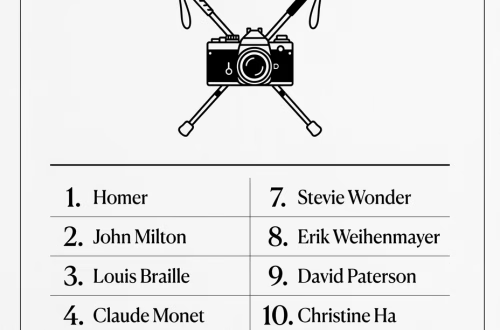
I’m not alone in this pursuit. There are perhaps a couple dozen known blind or visually impaired photographers worldwide—creative souls like Pete Eckert, who shoots conceptually from memory and imagination; Evgen Bavčar, whose work explores photography as a conceptual language; Alice Wingwall; Henry Butler; and others who’ve turned limitation into innovation. Some rely entirely on sound, touch, and visualization; others, like me, cling to that remaining bit of sight. We’re a small but stubborn group, proving that the urge to create images doesn’t vanish when eyesight does.
For me, it’s about holding onto joy. Photography keeps me connected to people, to places, to the fleeting beauty of everyday life. Even if I only glimpse a fraction of the 24x36mm frame on film, that fraction matters. It keeps me alive in ways nothing else quite does.
So yeah, I’m a blind photographer. It’s a contradiction that makes perfect sense to me. And as long as I can hold a camera steady, I’ll keep shooting. The world can stare all it wants, I’m too busy chasing the next shot in the dark.
-
Blob City
I’ve spent many sleepless nights trying to find the right words to describe what it’s like to go completely blind. It’s not like flipping off a light switch! For most people who are blind, about 90% according to the stats, there’s still something to see. Maybe it’s just light perception, like knowing the sun’s out there doing its thing, or maybe it’s catching a glimpse of colors, like a fuzzy rainbow. But for a few folks I know who’ve been completely blind since birth, sight is just one piece of the sensory puzzle, and they prove you can live a full, vibrant life without it. Me? I’m somewhere near the end, navigating a world of blobs, and let me tell you, it’s a wild ride.
Let’s get one thing straight: life without sight isn’t easy, but it’s absolutely worth living to the fullest. I mean, who needs 20/20 vision when you’ve got stubbornness, a good sense of humor, and a knack for dodging furniture? (I still bump into things, but I’m working on my ninja skills.) The world of blindness is filled with challenges, but it’s also brimming with possibilities. I love chatting with people about the tech that’s out there, like screen readers, smart canes, apps that describe the world like a chatty tour guide. But the real MVP in my life is Braille.
Braille is like the secret handshake of the blind community. It’s tactile, it’s elegant, and it keeps my brain as sharp as a tack. Fun fact: reading braille lights up the same part of your brain as reading with your eyes. So, while I’m running my fingers over those delightful dots, I’m basically doing mental push-ups. Without braille, I’m not sure I’d be as happy as I am today. It’s my bridge to a world of books, notes, and magazines.
I’ve been blind in one eye since I was a day old, thanks to a condition called Septo-Optic Dysplasia, which led to Optic Atrophy. Sounds like a villain from a sci-fi flick, right? Basically, it means my optic nerve cells are slowly checking out, like guests leaving a party early. Back in the 1970s, though, I didn’t let that stop me. I was just another kid, tearing around on bikes and motorcycles, channeling my inner Evel Knievel. Sure, I had more crashes than the average daredevil—my nickname was and still is “Crash”—but I didn’t care. My parents were my biggest cheerleaders, telling me I could do anything. I still believe them.
In January 2024, my doctor dropped a bombshell: “Stop driving.” The next month, another gut-punch: I had about two years of sight left. We hoped it’d stretch longer, but my vision had other plans. Right now, I’m down to five degrees of peripheral vision, and it’s blurry, like looking through a foggy window. Everyone and everything is a blob. My wife, Deana has been my rock through this whole journey, encouraging me to keep going, even when I’m tempted to throw a pity party for one.
Here’s what it’s like to live in Blob City. I can still pick up colors, so I might notice a red hat or a green shirt, but details? Forget it. Reading text is like trying to solve a puzzle in a windstorm. I have to stare at it forever, and it better be in font size “Billboard.” Walking, though, is my jam. It clears my head and usually puts me in a better mood. This morning, I strolled down to Green Valley Park, looped around the lake, and decided to grab Deana a drink from the gas station on the way back. Easy, right? Wrong.
I sauntered up to the cooler, ready to be the hero of hydration, only to remember I couldn’t read the labels. Picture me, squinting like a detective at a crime scene, trying to guess which bottle was Deana’s favorite. I grabbed one that looked vaguely familiar and hoped for the best. Then, a kind stranger piped up: “Need any help?” I could’ve hugged him. He confirmed I’d picked the right drink, then asked, “How’d you figure that out?” I explained my blob-vision situation, and he was surprised. Like most folks, he saw my white cane and dark glasses and assumed I was living in total darkness. Nope, just blob central.
That white cane and dark glasses? It’s like the unofficial “blind uniform.” People see it and assume I can’t see a thing, which is honestly a safe bet. I don’t mind the assumptions, better safe than sorry, right? Most people are just trying to help, and I’m grateful for it. I always say “thank you,” even if I don’t need the assistance. The other day, someone offered to guide me across the street, and I thought, Buddy, I’ve been crossing streets since disco was king. But I smiled, said thanks, and let them feel like a superhero. It’s a win-win.
The truth is, every blind person’s experience is different. Some of us see blobs, some see light, some see nothing at all. What we all share is the ability to adapt, to find joy in the little things, and to keep moving forward. For me, that means laughing at my own misadventures, like the multiple times I called a Mister a Misses or vice versa. That can get dicey really quick.
Losing my sight hasn’t been easy, but it’s taught me to lean into life’s unpredictability. I’m still the kid who rode motorcycles and dreamed big, just with a few more battle scars and a better sense of humor. With Deana by my side, braille to keep me sharp, and the occasional kind stranger to point me toward the right soda, I’m living a life that’s full, messy, and mine. So here’s to the blobs. May they always be colorful, and may I never stop finding the humor in this wild, blurry world.
-
Purblind Illumination
As many of you know, the revelation of my impending vision loss has sparked a sense of urgency and a poignant mission within me: to document the world through my lenses while time allows. The launch of “Purblind Illumination,” a title that playfully embraces the oxymoron of seeking light amidst gathering darkness, is more than a project. It’s a journey—a visual odyssey that I intend to share bi-monthly, if not with greater frequency.
Photography has been a beloved craft that has participated in the ebb and flow of my life since I first cradled a camera. The weight of a Pentax, the click of a Minolta shutter—these are the sensations that have charted the course of my passion. With decades of film and digital imagery behind me, my love for photography has never waned. It endures as the consistent, silent witness to my life’s narrative. There’s an undeniable truth I’m facing: the day is approaching when my eyes will no longer bear witness to the crisp edges and contrast of the world. But until then, I am committed to capturing as much as I can, to embrace, through my craft, every remaining photon that graces my vision.
“Purblind Illumination” is not only a testament to an enduring artistic spirit but also a tangible means to sustain my ardor for film. The magazines and books, rich with the past and vibrant with the present, are emblematic cords tying me to the world of visual storytelling, supporting the transition to a landscape of different sensations. The debut issue, modestly priced at $10, is an invitation for patrons to partake in this voyage—each purchase a beacon that not only illuminates the path for future works but also lights a candle of solidarity in our collective journey through the arts.
At the heart of this endeavor, and the very soul of my support network, stands my incredible wife. Her patience and understanding, as endless as space, have given me both the time and space to delve into the thralls of photography and to crystallize these moments into magazines and books. Without her, the narrative of “Purblind Illumination” would remain untold. Her role in this journey cannot be overstated; she is not just the unsung hero behind the scenes but the very foundation upon which this creative edifice stands. To her, I extend my deepest gratitude. I love you, Deana.
To the community: Your support and enthusiasm provide the resolve to push past the encroaching shadows. Each snap of the shutter is a tribute to your encouragement—a melodic verse in our shared symphony of life and art. Thank you for joining me on this expedition, as we illuminate the canvas of the world together, one frame at a time.