-
Why Every Office Door in City Hall Must Have Raised Lettering and Braille: ADA Signage Requirements for Municipal Public Buildings
A Guide for Advocates and Citizens Who Are Blind or Visually Impaired
More Than a Legal Checkbox
Imagine arriving at your city’s municipal building to pay a utility bill, apply for a permit, or attend City Council meetings and having no way to know which door leads where. No readable signs. No way to distinguish the Tax Assessor’s office from the City Clerk’s office from a utility closet.
For the more than 7.6 million Americans living with visual disabilities, this is not a hypothetical scenario. It is every day.
The Americans with Disabilities Act (ADA) established federal standards for accessible signage in public buildings, standards that many municipalities still fail to meet. This post breaks down exactly what the law requires, why it matters, and why raised lettering and Braille at every office door isn’t just a legal obligation, it is a basic act of respect and dignity.
What the ADA Says About Signage
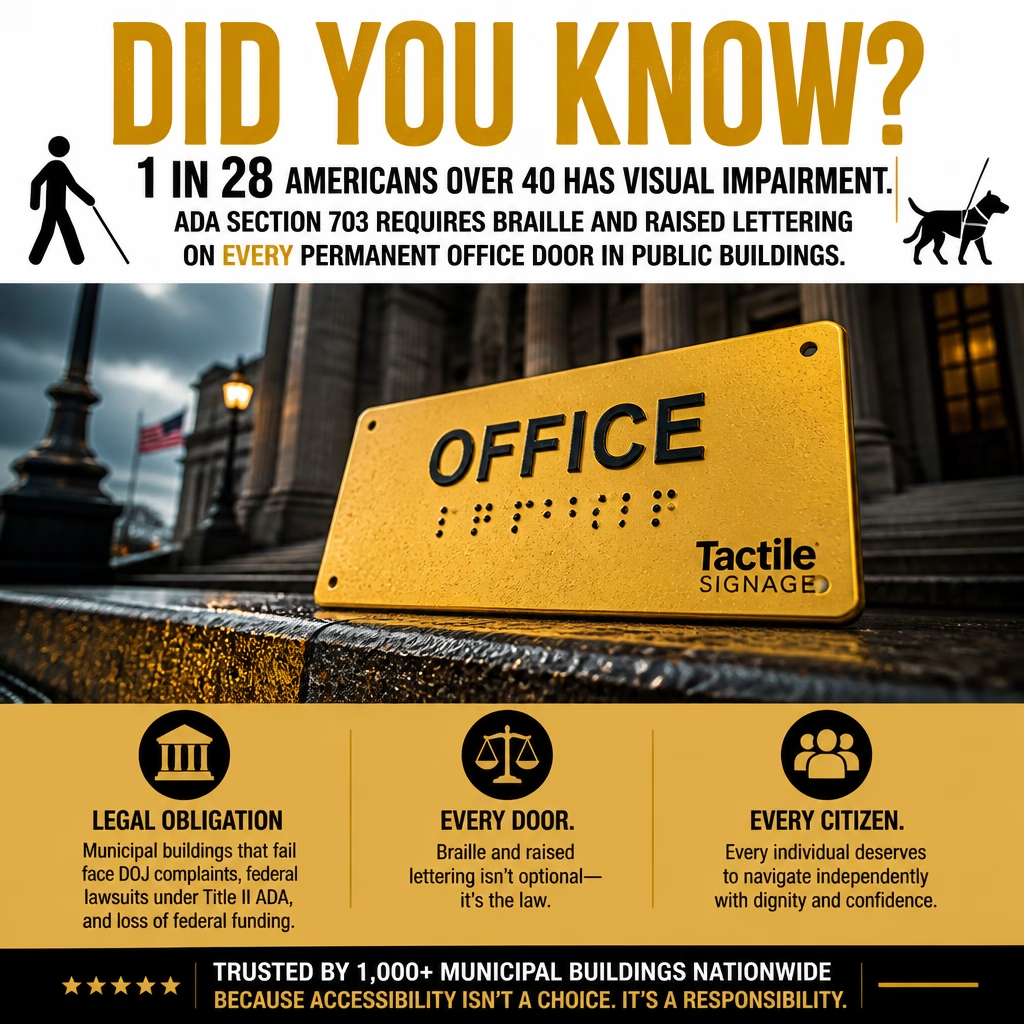
The ADA Standards for Accessible Design, specifically Section 703, establishes requirements for signs in public facilities. These requirements apply directly to city and county municipal buildings, including courthouses, city halls, permit offices, public health departments, libraries, and more.
Signs That Must Have Raised Characters and Braille
Under ADA standards, any sign that identifies a permanent room or space must include:
- Raised (tactile) characters — letters and numbers that project at least 1/32 inch from the sign’s surface
- Grade 2 Braille — the contracted form of Braille used by most Braille readers
- Both uppercase and lowercase letters — raised characters must use uppercase letters only, but visual characters on the same sign may use mixed case
This requirement applies to every permanent room in a municipal building, including:
- Individual office doors (City Clerk, Tax Assessor, Building Permits, etc.)
- Conference rooms
- Restrooms
- Stairwells and exit doors
- Storage and utility rooms accessible to the public
- Elevator lobbies and floors
Placement Requirements
The ADA is specific about where tactile signs must be mounted:
- On the wall on the latch side of the door — the side where the door handle is located
- Centerline between 48 and 60 inches from the finished floor, placing the Braille and raised characters within reach of most adults and wheelchair users.
- At least 18 inches from the nearest corner, ensuring a person can approach without bumping into the door as it swings open
This placement is not arbitrary. It allows a blind or visually impaired person to locate the sign predictably, approach safely, and read it with their fingertips without guessing where to reach.
Character and Braille Specifications
- Raised characters must be between 5/8 inch and 2 inches in height
- Characters must have a sans-serif font (no decorative serifs that complicate tactile reading)
- There must be a non-glare finish on the sign surface
- Characters must contrast visually with the sign background (for those with low vision)
- Braille dots must follow specific dome height and spacing requirements per ANSI/ICC A117.1 standards
Why Municipal Buildings Must Do Better: 10 Reasons Braille and Raised Lettering Matter
1. Independence Is a Civil Right
The ADA was signed into law in 1990 with a foundational principle: people with disabilities have the right to participate fully in civic life. A blind resident cannot independently navigate a city building without tactile signage. Dependence on sighted assistance for something as basic as finding an office strips away autonomy that every citizen deserves.
2. Municipal Buildings Serve Everyone, Including Blind Taxpayers
City halls, county courthouses, and public service offices exist to serve all residents. Blind and visually impaired citizens pay the same taxes, hold the same rights, and require the same services as sighted residents. Accessible signage is not a special accommodation, it is equal service.
3. Visual Impairment Is More Common Than Most Realize
According to the CDC, approximately 1 in 28 Americans over age 40 has some form of visual impairment. Age-related vision loss, macular degeneration, glaucoma, diabetic retinopathy — means that the population of people who benefit from tactile signage grows every year. Seniors accessing Medicare offices, veteran services, or property tax assistance are disproportionately affected.
4. Low Vision ≠ No Vision: High-Contrast Signage Helps Too
Not everyone who benefits from accessible signage is completely blind. People with low vision, those who cannot read standard print even with glasses benefit enormously from high-contrast visual signs combined with tactile elements. The ADA’s signage standards address both populations simultaneously.
5. Braille Literacy Is a Lifeline, Not a Relic
Some assume that audio technology has replaced Braille. It has not. Studies consistently show that Braille readers have significantly higher employment rates and literacy levels than blind individuals who do not read Braille. Providing Braille signage validates and supports Braille literacy and acknowledges that technology (phones, screen readers) should supplement, not replace, physical accessibility.
6. Tactile Signs Enable Quiet, Private Navigation
Relying on a phone’s GPS or asking a stranger for help every time you approach a door is not a dignified or feasible. Tactile signage allows a blind person to navigate confidently and quietly without announcing their destination to everyone nearby, which matters especially in sensitive settings like public health offices, legal aid, or social services.
7. Consistent Signage Reduces Anxiety and Increases Confidence
For individuals navigating a new or unfamiliar building, predictability is everything. When tactile signs are consistently placed on the latch side of every door at the same height, a blind person can build a mental map of the space efficiently. Inconsistent or missing signage creates frustration, confusion, and safety risks.
8. It Protects the Municipality from Legal Liability
Municipalities that fail to meet ADA signage standards are subject to:
- Complaints to the U.S. Department of Justice
- Civil lawsuits under Title II of the ADA, which applies directly to state and local government entities
- Loss of federal funding, cities receiving federal grants must comply with Section 504 of the Rehabilitation Act, which has parallel accessibility requirements
Proactive compliance is far less costly than litigation, settlements, or federal audits.
9. It Sets a Standard for the Entire Community
When a city hall models full ADA compliance, it sends a message to local businesses, schools, and organizations. Municipal buildings are civic anchors, what they do (or fail to do) shapes community norms around accessibility. Leading by example has a ripple effect throughout the entire community.
10. People Are Waiting
Every day that a municipal building operates without compliant tactile signage is another day that a blind resident cannot find the Building Permits office independently or attend those City Council meetings. Another day someone must ask for help to find a restroom. Another day a veteran cannot locate the VA liaison’s door without assistance. The harm is not theoretical, it is ongoing reality.
Common Violations to Watch For in Municipal Buildings
If you are an accessibility advocate, a blind resident, or a city official conducting an audit, here are the most frequent ADA signage violations found in municipal buildings:
- Signs mounted on the door itself rather than the adjacent wall
- Signs placed too high or too low — outside the 48–60 inch centerline range
- Pictogram-only signs without accompanying raised text and Braille
- Braille that is incorrect or outdated — some older signs use Grade 1 Braille, which does not meet current standards
- Glare-producing sign finishes that reduce legibility for low-vision users
- Insufficient contrast between characters and sign background
- Temporary or paper signs substituting for permanent tactile signs
- Missing signs on rooms that have been repurposed without updating signage
What Advocates and Residents Can Do
File a Complaint
Anyone can file an ADA Title II complaint with the U.S. Department of Justice Civil Rights Division at www.ada.gov or call 1-800-514-0301 (Voice) / 1-800-514-0383 (TTY).
Request a Self-Evaluation
Under ADA Title II, local governments are required to conduct a self-evaluation of their programs and facilities. Residents can formally request that a city conduct or update its self-evaluation and transition plan.
Connect With Your State’s Protection & Advocacy Organization
Every state has a federally funded Protection & Advocacy (P&A) organization that provides free legal assistance to people with disabilities. They can help you navigate complaints or advocate for systemic change.
Attend City Council Meetings
Accessibility issues in public buildings are legitimate policy concerns. Showing up to public comment periods and city council meetings puts pressure on elected officials to allocate budget for ADA compliance upgrades.
Conclusion: Braille on Every Door Is Not Too Much to Ask
A small tactile sign, a few raised letters, a line of Braille dots, costs very little. What it provides is immeasurable: the ability to move through a public building independently, privately, and with confidence.
Municipal buildings belong to everyone. The blind resident who needs to renew a license, attend a hearing, or access public records deserves the same frictionless experience as any sighted visitor. Raised lettering and Braille signage at every office door is not a luxury upgrade. It is not only the Law but also the right thing to do.
-
My ‘Gotcha’ Moment: Tech and Blindness Misunderstandings
Mondays with decent weather mean one thing: a walk to my favorite local spot, BeanStalk Coffee on Main Street here in Norman, Oklahoma. I cut through the brisk wind, navigate the crosswalks with my cane tapping the way, and arrive around 8 AM feeling accomplished.
I order my usual drip coffee (the barista kindly brews a fresh batch when it’s low), grab it when it’s ready, and head outside to a bench a few hundred feet away. Coffee in one hand, I settle in, pull out my iPhone, and start scrolling through Instagram the way I always do.
That’s when it happened. A guy approaches, big smile on his face, and hits me with: “I caught ya!”
I laugh. What else do you do? Still grinning like he’s uncovered some big secret, he points out my white cane and says something like, “You’re blind… but you’re looking at your phone”.
Cue my internal laughter. I smiled back and asked, “Can you see the hearing aids in my ears?”
He said, yes.
Then I explained: “I’m using VoiceOver, the built-in screen reader on my iPhone. It reads everything out loud, and since my hearing aids are Bluetooth, the audio pipes straight into my ears. No need to see the screen at all.”
His jaw dropped. He was genuinely blown away. He apologized right away, called me a “high-tech blind dude,” and we chatted for a minute before he walked off, probably a little wiser.
This isn’t the first time. Over the past year since I started using my cane full-time, I’ve had plenty of these “gotcha” moments. People spot the cane, see me on my phone (or “looking” at it), and assume I’m faking it for attention or sympathy. It’s frustrating, but honestly. It makes me laugh more than anything now. Because the reality is so different from what most folks imagine.
Blindness is a spectrum, and tech has changed everything. VoiceOver (and similar tools like TalkBack on Android) lets us browse social media, text, read emails, check the weather, navigate maps, shop online, you name it. The phone speaks to us, we gesture or use commands to interact, and Bluetooth hearing aids or bone-conduction headphones make it seamless and private. No squinting, no magnification needed if you don’t have usable vision. It’s not magic; it’s just smart design from Apple and others that’s been around for years.
Yet the myth persists: “If they’re blind, they can’t use a phone.” Or worse: “They must be faking because they’re looking at the screen.” I’ve seen it online as well, photos of cane users on phones sparking comment wars, people confidently declaring fraud. It hurts because it comes from ignorance, not malice most of the time. And it makes some of us self-conscious about pulling out our devices in public, like we’re doing something wrong.
But we’re not. Scrolling Instagram on a bench with a coffee? That’s just being human. Checking the time, replying to a message from a friend, reading a blog post like this one. It’s independence, not deception.
To my fellow blind and low-vision folks: Don’t let these encounters dim your day. Keep using your tech proudly. It’s not a contradiction; it’s progress. If someone says something like above, you don’t owe them a full demo, but if you’re in the mood, a quick, calm explanation can plant a seed. Like I did that day: mention VoiceOver, point them to Settings > Accessibility > VoiceOver on their own phone, and watch their perspective shift.
And to the sighted world reading this: Blindness doesn’t look one way. We don’t all wear dark glasses 24/7, although I do a lot of the time, stare blankly ahead, or avoid tech. Many of us have some residual vision, or we use tools that let us engage with the world on our terms. The next time you see someone with a cane on their phone, resist the urge for a “gotcha.” Curiosity is fine. Ask if you’re genuinely interested. But assumptions? They just make things harder for everyone.
Patience really is key in our world. The sighted world often doesn’t get it, and that’s okay, they haven’t lived it. But we can bridge that gap by educating when we have the energy, supporting each other, and refusing to shrink ourselves to fit outdated stereotypes.
So, I got “busted” Monday. But really? I was just living my life, coffee, cane, bench, and a phone that talks to me. And that’s not faking anything. That’s thriving.
What’s your story? Have you had a similar “gotcha” moment? Drop it in the comments. I’d love to hear your stories. We’re all in this together.
Stay high-tech, stay patient, and keep tapping those routes.
Jefferson (the high-tech blind dude) 🇺🇲