Blind Visionaries: 11 People Who Proved Sight Isn’t the Same as Vision
Disability Awareness Month
There’s a lazy assumption baked into the English language itself: that “vision” means eyesight, that “seeing” means understanding, that “insight” requires a working pair of eyes. The people on this list spent their lives quietly, sometimes loudly, disproving that assumption. They didn’t succeed despite being blind so much as they succeeded as blind people, full stop, doing the work in front of them until the work was undeniable.
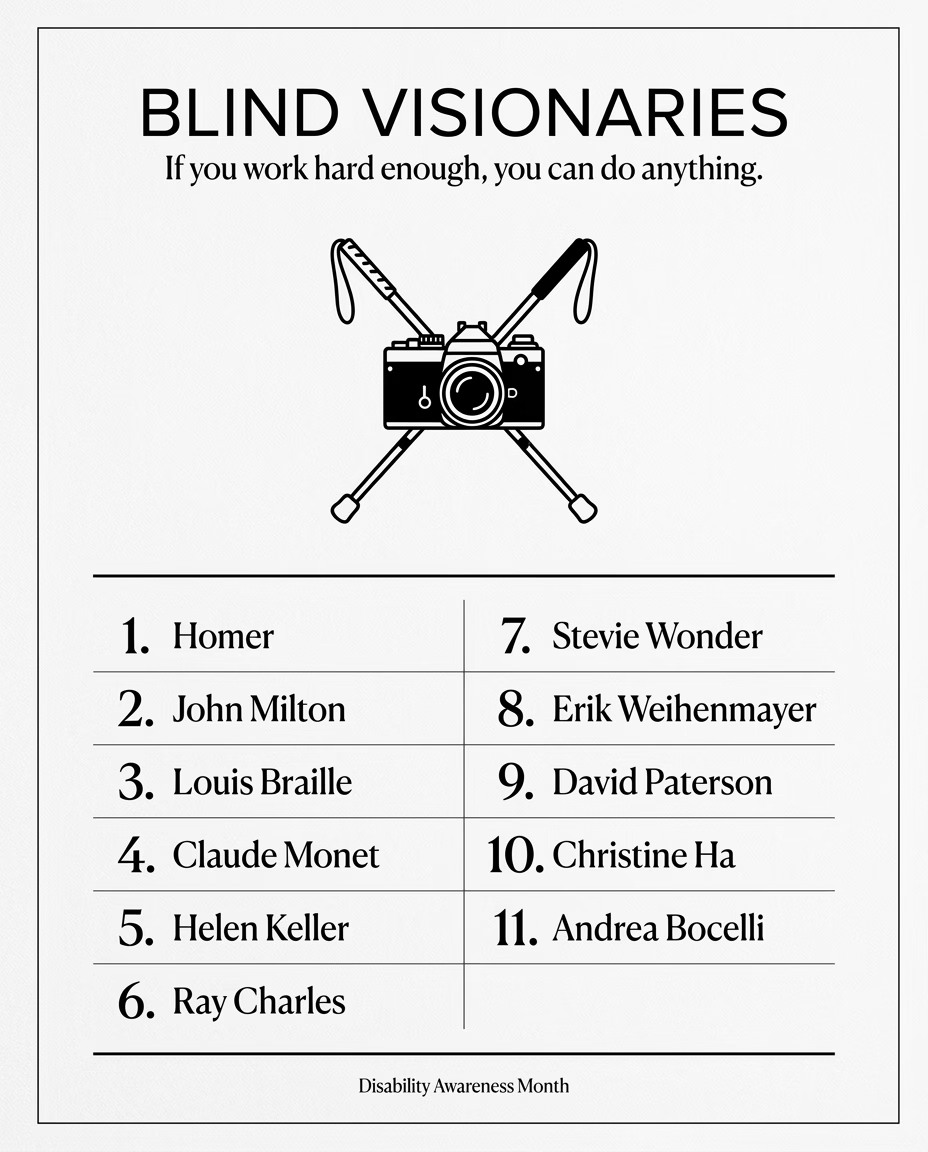
Homer (c. 8th century BCE) Ancient tradition holds that the poet credited with the Iliad and the Odyssey, two works that shaped Western literature for the next 2,800 years, was blind. Whether or not that’s literal history, “Homer” became an archetype: proof that the tradition of blind storytellers is as old as storytelling itself.
John Milton (1608–1674) Milton was already a respected poet and pamphleteer when he went completely blind in his mid-40s. He didn’t stop writing, he dictated Paradise Lost, one of the greatest epic poems in the English language, line by line to his daughters and assistants.
Louis Braille (1809–1852) Blinded in a childhood accident, Braille spent his teenage years at the Royal Institute for Blind Youth in Paris developing a tactile reading and writing system based on raised dots. He was 15. That system still bears his name and still opens up literacy for blind people worldwide.
Claude Monet (1840–1926) Cataracts crept in during Monet’s 60s, and by his early 80s he was legally blind, seeing the world through a yellow-brown haze that reshaped his palette entirely. He kept painting anyway — the massive, immersive Water Lilies murals now in the Musée de l’Orangerie were largely completed while his sight was failing.
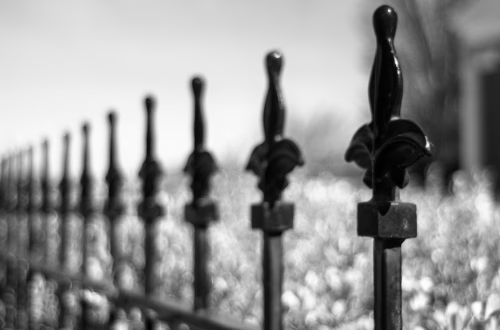
A personal aside on this one. I’m severely visually impaired myself, and I still pick up a camera most days. So I’ll admit I have a soft spot for Monet that goes beyond the history books. When I put my eye up to the viewfinder now, I can’t just look and see. I have to scan the frame left to right, top to bottom, like a printer laying down a page, and hold each piece in my mind until I’ve stitched together something like a true picture of the scene — blurry, incomplete, but true. It takes time. It takes patience. Most of the critics who write about Monet’s late work talk about it like a tragedy that happened to a genius — the poor man, painting through the fog. I don’t read it that way. I think he was doing the same thing I do at every viewfinder: piecing together a whole scene from a vision that only gives you fragments at a time, and trusting the patience of that process instead of quitting because his eyes weren’t what they used to be. I don’t think you can fully understand that decision until you’ve had to make something honest out of a blurred, partial view of the world.
Helen Keller (1880–1968) Deafblind from infancy after an illness, Keller learned to communicate through her teacher Anne Sullivan and went on to graduate from Radcliffe College, write a dozen books, and become one of the most influential advocates for disability rights, women’s suffrage, and workers’ rights of the 20th century.
Ray Charles (1930–2004) Blind by age seven from glaucoma, Charles built a career that fused gospel, blues, jazz, and country into something entirely his own and in the process became one of the most influential musicians in American history.
Stevie Wonder (b. 1950) Blind since shortly after birth, Wonder was a Motown prodigy by age 13 and has since won 25 Grammy Awards, written some of the most enduring songs of the 20th century, and remained a fierce advocate for accessibility and civil rights.
Erik Weihenmayer (b. 1968) Blind since age 13 from a rare eye disease, Weihenmayer is the only blind person to reach the summit of Mount Everest, and he didn’t stop there, going on to complete the Seven Summits and kayak the length of the Grand Canyon.
David Paterson (b. 1954) Legally blind since infancy due to an infection, Paterson built a career in New York state politics and became Governor of New York in 2008, the first legally blind person to serve as a U.S. governor.
Christine Ha (b. 1979) Ha began losing her vision in her 20s to a rare autoimmune condition, right around the time she was falling in love with cooking. In 2012 she became the first blind contestant and winner of MasterChef US, and later opened her own celebrated restaurant, The Blind Goat, in Houston.
Andrea Bocelli (b. 1958) Born with poor eyesight and blinded completely at age 12 after a soccer accident, Bocelli went on to become one of the best-selling artists in music history, bringing opera to audiences who’d never have sought it out otherwise.
None of these people were handed anything. They read by dots under their fingertips, or dictated a masterpiece word by word, or cooked by touch and smell in front of judges who doubted them, or climbed a mountain that kills people who can see just fine. The through line isn’t blindness, it’s the refusal to let blindness be the whole story.
That’s the point of this list, and it’s the point of this month: work hard enough, at the right thing, for long enough, and you can do more than anyone expected, including, sometimes, yourself.
Discover more from Jefferson Davis — Blind Photographer, Advocate, Writer
Subscribe to get the latest posts sent to your email.

You May Also Like
Why Every Office Door in City Hall Must Have Raised Lettering and Braille: ADA Signage Requirements for Municipal Public Buildings

Snow Ice Walkabout Adventure: A Monday Encounter