-
Why We Moved from Arizona to Norman, Oklahoma: A Personal Journey
For over a year, my wife and I had been on an exhausting search for a used home we could actually afford in Arizona. With housing prices skyrocketing and my vision declining, our choices felt increasingly narrow. We could have stayed and poured every dollar into exorbitant rent, leaving us scraping by without enough for basics like food, or we could pack up and start fresh elsewhere. As much as we both adored Arizona’s landscapes, climate, and memories, it simply wasn’t sustainable. Tough as it was, we knew it was time to leave.
My wife’s family roots run deep in the Norman, Oklahoma area, and I’d fallen in love with the place during a week-long visit we took a while back. The friendly vibe, the open spaces, and the genuine warmth of the people stuck with me. So, we turned our sights eastward. In Arizona, even a modest one-bedroom felt out of reach on our average salaries, but crossing a couple of states into Oklahoma opened up possibilities we hadn’t dreamed of. After months of careful research, heartfelt discussions, and weighing every pro and con, we took the plunge and bought a charming three-bedroom home right here in the Norman area.
We’ve been in our new house for nearly a month now, still surrounded by half-unpacked boxes and bubbling with that new-home excitement and aching back. The sense of community here feels real and immediate, a far cry from the isolation we sometimes felt before.
Just the other day, for the first time since moving in, I ventured out for a longer adventure: a roughly four-mile walk exploring parts of the city. Downtown Norman is buzzing with activity these days, with quite a bit of construction reshaping the area, new developments, infrastructure upgrades, and revitalization projects that promise to breathe even more life into the heart of the city. Navigating those zones as a legally blind guy could have been tricky, but the construction crews were incredibly kind and patient, guiding me safely through the hazards with clear directions and helpful hands. I had an absolute blast chatting with folks along the way, strangers who stopped to talk, share stories, or just say hello. The whole experience left me feeling safe, connected, and invigorated.
That said, Norman isn’t without its challenges. Like many growing cities, there’s a visible issue with homelessness, and the city council has been deeply engaged in debates about solutions, including proposals for a permanent shelter funded through a bond vote. With budget deficits and ongoing discussions about priorities, it’s a complex topic that reflects the city’s commitment to addressing real needs while balancing resources. But beneath those growing pains, Norman brims with character, the kind that’s hard to find in bigger, more polished places. The people here are genuinely great: down-to-earth, helpful, and quick to lend a hand.
As a classic university town, home to the University of Oklahoma, Norman pulses with energy. You’ll encounter all walks of life, students, professors, families, artists, and athletes creating a vibrant mix that’s always refreshing. There’s constantly something happening: games at the stadium, events on campus, festivals, or just the lively hum of daily life. It’s big enough to feel like a proper city (without the overwhelming chaos of nearby Oklahoma City), yet it retains that welcoming, small-town heart, perfect for this country fella who’s always preferred wide-open spaces over endless sprawl.
The one thing I’m still hunting for is that perfect coffee spot with the right community feel. There are plenty of options within easy walking distance, Starbucks, Dutch Bros, Stella Nova, and more, but they’re not quite hitting the mark for me. Back in Payson, Arizona, I was a regular at Common Grounds, a true local hangout where folks gathered every morning to chat, catch up on news, and build real connections. They even kept my own dedicated coffee mug on a special hook, complete with Braille labeling so I could find it easily. It felt like home.
Here in Norman, I’m optimistic I’ll discover something close. I’m planning to explore them one by one until I find that spot where I can become a regular again.
All in all, we’re thrilled to be here in Norman, putting down roots and embracing this new chapter. Our home feels like a true blessing, spacious, affordable, and filled with potential.
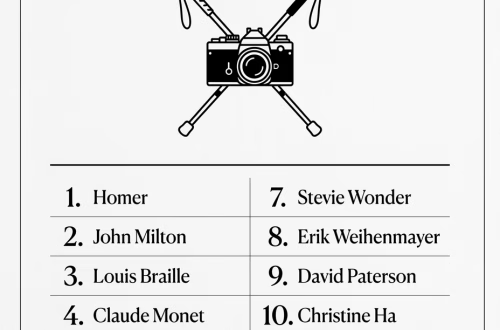
As we get more settled, I look forward to sharing more stories and diving back into writing about my lifelong passion: photography and vintage film cameras. Being legally blind hasn’t dimmed that love one bit. With no useful vision in my left eye and just a narrow 5-degree tunnel in my right, the world is mostly shadows and shapes to me. But photography has been part of my life for decades. It’s about feeling the moment, composing through instinct and memory, and capturing beauty in ways that transcend sight. Old film cameras, with their tactile controls and timeless mechanics, are especially magical. I can’t wait to talk more about them soon!
-
Sowing the Seed
Photography captures more than just images; it encapsulates moments of raw emotion, unveiling stories through the interplay of light, and time. The act of clicking the shutter is an affirmation of the photographer’s intent, a definitive selection of a single frame from the boundless flow of life.
Consider the potent significance of that solitary click—the pivotal heartbeat wherein the photographer and the captured moment converge in a silent conversation. “This one photo speaks volumes,” the artist muses; it’s an acknowledgment that the photo holds an essence that transcends the visual, striking a chord that resonates with the viewer’s innermost sentiments.
In this silent exchange between the observer and the observed, the photograph becomes a linguistic artifact. Its voice may whisper or shout, but the volume it speaks with is not one measured in decibels, but in affect..
As the image is revealed, developed, and shared, it begins a journey of interpretation and inspiration. Each viewer, drawn into the frame, becomes part of the unfolding narrative, extending the heartbeat of the captured moment to echo endlessly through the halls of human experience.
As I strolled through the quaint streets of the small town I’ve come to know as home, nestled in the Upstate of South Carolina, my gaze was drawn to a particular structure that stood as a testament to the past. It was an aging old bank that seemed to wear its history on its facade. The building was unmistakably a product of the 60’s architecture, characterized by its angular brick design. Such structures are commonplace in this part of town, each telling a story of the era they were erected in.
Despite its clear ongoing renovation, the exterior gave away the years of neglect. The reddish-brown bricks, once probably lively and inviting, were now dulled with a patina of decay—crumbling pointing between them told tales of the many years they had weathered. The signs of pollution had left their marks, etched into the surface in grime and soot. Acid rain had washed over the walls for decades, nibbling away at the solidity of the mortar, and with each passing year, the relentless tide of time had carved its impressions deeper into the once-pristine brickwork.
As I continued my walk, I couldn’t help but feel a pang of nostalgia mixed with a hopeful curiosity for the building’s future. The old bank, once a bustling hub of commerce, now stood quietly amidst more modern establishments, a relic of a bygone era awaiting its rebirth. It served as a stark reminder of the impermanence of man’s creations, standing defiantly against the inescapable march of time, awaiting the day it would once again stand proud and renewed, its decayed exterior merely a chapter of its enduring story. It reminded me that in every end, there’s the whisper of a new beginning, and I was witnessing a small piece of this town’s continual evolution.
As I neared the old, weathered wall that had always been a part of my daily route, something unusual caught my eye. It was a solitary weed, displaying a resilience that was both unexpected and beautiful, blooming with a delicate flower in the midst of the unforgiving brickwork. Its struggle for life against the rigid urban canvas captivated me.
Quickly, I reached for my beloved Pentax K1000, a camera that had become an extension of my own being. Equipped with my preferred Zenit Helios 44K-4 lens – a piece of glass famous for its swirly bokeh and the soulful images it produces – I framed the shot with a mindful respect for the weed’s tenacity. The viewfinder gave me connection between subject and artist as I adjusted the focus ring, the tactile sensation reminding me why I fell in love with photography in the first place.
With a click, the shutter closed for a fraction of a second, capturing not just an image but encapsulating a story of survival and beauty in adversity. I stood there for a moment, basking in the satisfaction that comes from knowing when you’ve caught a magic moment on film. This photograph, I sensed, would be a cherished addition to my personal collection, a reminder that even in the most unexpected places, there’s always something extraordinary to be discovered. I knew in that instant that I had something that I, at the very least, would love.
Even amongst the grot and grim of this old decrepit bank, new life emerges. God is everywhere and in everything we see. He is the Alpha and the Omega, the beginning and the end. This weed withered away, but for a short time it bloomed. Jesus’ parable about the sower and the seed is one of my favorites and I thought of it instantly, as I took this photograph. God speaks, if we listen.
Mark 4; 3-93 “Listen! Behold, a sower went out to sow. 4 And as he sowed, some seed fell along the path, and the birds came and devoured it. 5 Other seed fell on rocky ground, where it did not have much soil, and immediately it sprang up, since it had no depth of soil. 6 And zwhen the sun rose, it was scorched, and since it had no root, ait withered away. 7 Other seed fell among bthorns, and the thorns grew up and choked it, and it yielded no grain. 8 And other seeds fell into good soil and produced grain, growing up and increasing and yielding thirtyfold and sixtyfold and ca hundredfold.” 9 And he said, d“He who has ears to hear, let him hear.”