Photography
-
A Shot in the Dark: Still Chasing Light as a Blind Photographer
Hi, I’m Jefferson Davis, I’m a photographer. It still feels a little absurd saying that out loud sometimes, like confessing a quirky habit at an awkward support group meeting. “Hi, my name is Jefferson, and I’m a blind guy who insists on taking pictures.” But here I am, more than five decades into this wild ride on planet Earth, still hauling cameras around and clicking shutters, even as my vision fades.
It all started way back when I was just one day old. I contracted spinal meningitis in the hospital, a brutal infection that nearly ended my story before it really began. I survived, but the damage was done. It triggered Septo-Optic Dysplasia, a condition that destroyed my left eye in infancy and set off a slow, relentless optic atrophy in my right. Over the years, that right eye has dwindled to about five degrees of usable vision, a tiny peephole into the world, and nothing at all in the left. It’s progressive, irreversible, and one day, likely soon, that small window will close completely. But here’s the honest truth: I’m grateful for the sliver I still have. It lets me glimpse shapes, contrasts, and colors in a way that keeps me tethered to the visual world I’ve loved for so long.
Molly Burke, the advocate and podcaster who’s built a platform around her own blindness, put it perfectly in a recent discussion (paraphrasing from memory): the physical challenges of not seeing are tough, but the social side of blindness, the stares, the assumptions, the isolation, is often the real gut punch. I couldn’t agree more. The cane, the fumbling, the daily adaptations? Those are hurdles I can navigate. It’s the way the world sometimes reacts that stings the deepest.
I still vividly remember my first few trips to the local coffee shop after my vision loss became obvious and I had to use the white cane. I’d walk in with my white cane tapping ahead, and the entire room would fall silent. Conversations halted mid-sentence. I could feel the eyes locking onto me, the unspoken questions hanging in the air: “What’s wrong with him?” “Is he really blind?” “Why is he even here?” The awkwardness was suffocating. It took weeks before the regulars adjusted. Eventually, the stares turned to nods, then smiles, then jokes. We started chatting about the weather, the latest news, or how strong the brew was that day. That shift felt like a small victory. But getting there required me to push through the discomfort, to show up anyway.
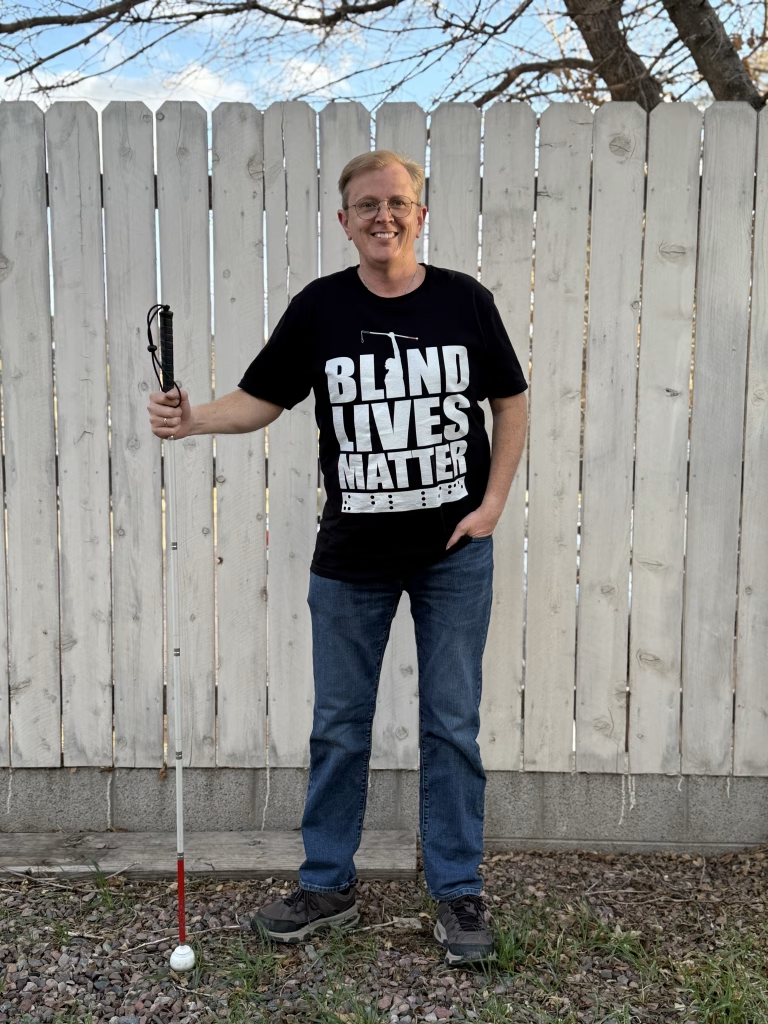
These days, the white cane is practically an extension of my arm. I don’t flinch when people stare or whisper. Until I receive a guide dog (and yes, I’ve had plenty of well-meaning folks ask when that’s happening), the cane is non-negotiable for safe, independent mobility. In the blind community, there’s a quiet understanding that guide dogs often carry less stigma. They’re seen as “heroic” or “inspirational,” while the cane can still evoke pity or confusion. But I refuse to let outdated attitudes dictate my choices. I go where I want, when I want, cane in hand, no apologies.
Now, to the part that really baffles people: I’m blind, and I still photograph. When I sling an old film camera over my shoulder, I can practically hear the mental gears grinding in onlookers heads. “Wait… he’s blind. Why is he taking pictures? How does that even work?” I’ve been interrupted mid-shot more times than I can count, strangers stepping right up, genuinely puzzled or sometimes skeptical, asking exactly that.
The answer is straightforward, at least to me. I’ve been making photographs for over 40 years. Some of it was casual fun, some professional gigs, but all of it rooted in a deep love for capturing moments. Losing most of my sight didn’t erase that passion; it just changed how I pursue it. Think about it this way: if you’d spent decades playing golf, perfecting your swing, chasing birdies on the green, dand then lost your vision, would you quit the game entirely? Or would you adapt, find new ways to feel the club, hear the ball drop, sense the course? Of course you’d try to keep playing. Photography is my golf. It’s the thing that lights me up, keeps me engaged with the world, and gives me purpose.
It’s not easy anymore, and I won’t sugarcoat that. I can’t see what’s in the frame most of the time. Shutter speeds and aperture markings? Forget it, unless I pull out my 22x magnifier, squint hard, and hold it up against the lens, those tiny numbers are a blur. Focusing is guesswork, composition relies on memory and, muscle memory, and sometimes just instinct. I frame shots based on what I think is there, drawing on decades of sighted experience. I listen to the sounds around me, feel the light on my skin, remember the layout of a familiar spot. Every click is a leap of faith.
And yet, when the film is scanned onto the computer, there’s magic in it. My wife helps me review them, and together we decide what works. Some images surprise even me; others capture exactly the feeling I was chasing. One day, when that last bit of vision is gone, she’ll still have those negatives, those files, those frozen slices of time. That’s enough for me.
Of course, not everyone gets it. The skeptics are the hardest to deal with, the ones who watch me pour creamer into my coffee at the same shop I’ve visited hundreds of times and decide they’ve “caught” me faking. They don’t realize I’ve memorized the counter layout, the position of the sugar packets, the pour spout on the creamer jug. It’s adaptation, not deception. I’ve had ophthalmologists, neurologists, specialists galore confirm the extent of my vision loss. But some people seem determined to prove otherwise.
I’m always open to genuine questions, though. If someone approaches with real curiosity, ”What’s the cane for?” “How do you know when to click?”, I’m happy to chat. Kids are the best at this; they haven’t learned to filter or judge yet. They’ll walk right up, point at the cane, and ask point-blank. Those conversations are gold. They remind me that education happens one honest exchange at a time.
The “why are you even bothering?” crowd, though? That gets old fast.
I’m not alone in this pursuit. There are perhaps a couple dozen known blind or visually impaired photographers worldwide—creative souls like Pete Eckert, who shoots conceptually from memory and imagination; Evgen Bavčar, whose work explores photography as a conceptual language; Alice Wingwall; Henry Butler; and others who’ve turned limitation into innovation. Some rely entirely on sound, touch, and visualization; others, like me, cling to that remaining bit of sight. We’re a small but stubborn group, proving that the urge to create images doesn’t vanish when eyesight does.
For me, it’s about holding onto joy. Photography keeps me connected to people, to places, to the fleeting beauty of everyday life. Even if I only glimpse a fraction of the 24x36mm frame on film, that fraction matters. It keeps me alive in ways nothing else quite does.
So yeah, I’m a blind photographer. It’s a contradiction that makes perfect sense to me. And as long as I can hold a camera steady, I’ll keep shooting. The world can stare all it wants, I’m too busy chasing the next shot in the dark.
-
Why We Moved from Arizona to Norman, Oklahoma: A Personal Journey
For over a year, my wife and I had been on an exhausting search for a used home we could actually afford in Arizona. With housing prices skyrocketing and my vision declining, our choices felt increasingly narrow. We could have stayed and poured every dollar into exorbitant rent, leaving us scraping by without enough for basics like food, or we could pack up and start fresh elsewhere. As much as we both adored Arizona’s landscapes, climate, and memories, it simply wasn’t sustainable. Tough as it was, we knew it was time to leave.
My wife’s family roots run deep in the Norman, Oklahoma area, and I’d fallen in love with the place during a week-long visit we took a while back. The friendly vibe, the open spaces, and the genuine warmth of the people stuck with me. So, we turned our sights eastward. In Arizona, even a modest one-bedroom felt out of reach on our average salaries, but crossing a couple of states into Oklahoma opened up possibilities we hadn’t dreamed of. After months of careful research, heartfelt discussions, and weighing every pro and con, we took the plunge and bought a charming three-bedroom home right here in the Norman area.
We’ve been in our new house for nearly a month now, still surrounded by half-unpacked boxes and bubbling with that new-home excitement and aching back. The sense of community here feels real and immediate, a far cry from the isolation we sometimes felt before.
Just the other day, for the first time since moving in, I ventured out for a longer adventure: a roughly four-mile walk exploring parts of the city. Downtown Norman is buzzing with activity these days, with quite a bit of construction reshaping the area, new developments, infrastructure upgrades, and revitalization projects that promise to breathe even more life into the heart of the city. Navigating those zones as a legally blind guy could have been tricky, but the construction crews were incredibly kind and patient, guiding me safely through the hazards with clear directions and helpful hands. I had an absolute blast chatting with folks along the way, strangers who stopped to talk, share stories, or just say hello. The whole experience left me feeling safe, connected, and invigorated.
That said, Norman isn’t without its challenges. Like many growing cities, there’s a visible issue with homelessness, and the city council has been deeply engaged in debates about solutions, including proposals for a permanent shelter funded through a bond vote. With budget deficits and ongoing discussions about priorities, it’s a complex topic that reflects the city’s commitment to addressing real needs while balancing resources. But beneath those growing pains, Norman brims with character, the kind that’s hard to find in bigger, more polished places. The people here are genuinely great: down-to-earth, helpful, and quick to lend a hand.
As a classic university town, home to the University of Oklahoma, Norman pulses with energy. You’ll encounter all walks of life, students, professors, families, artists, and athletes creating a vibrant mix that’s always refreshing. There’s constantly something happening: games at the stadium, events on campus, festivals, or just the lively hum of daily life. It’s big enough to feel like a proper city (without the overwhelming chaos of nearby Oklahoma City), yet it retains that welcoming, small-town heart, perfect for this country fella who’s always preferred wide-open spaces over endless sprawl.
The one thing I’m still hunting for is that perfect coffee spot with the right community feel. There are plenty of options within easy walking distance, Starbucks, Dutch Bros, Stella Nova, and more, but they’re not quite hitting the mark for me. Back in Payson, Arizona, I was a regular at Common Grounds, a true local hangout where folks gathered every morning to chat, catch up on news, and build real connections. They even kept my own dedicated coffee mug on a special hook, complete with Braille labeling so I could find it easily. It felt like home.
Here in Norman, I’m optimistic I’ll discover something close. I’m planning to explore them one by one until I find that spot where I can become a regular again.
All in all, we’re thrilled to be here in Norman, putting down roots and embracing this new chapter. Our home feels like a true blessing, spacious, affordable, and filled with potential.
As we get more settled, I look forward to sharing more stories and diving back into writing about my lifelong passion: photography and vintage film cameras. Being legally blind hasn’t dimmed that love one bit. With no useful vision in my left eye and just a narrow 5-degree tunnel in my right, the world is mostly shadows and shapes to me. But photography has been part of my life for decades. It’s about feeling the moment, composing through instinct and memory, and capturing beauty in ways that transcend sight. Old film cameras, with their tactile controls and timeless mechanics, are especially magical. I can’t wait to talk more about them soon!
-
Progressively Blind Photography
As someone on the cusp of complete blindness, I’ve found joy and frustration in equal measure within the vibrant online communities for the blind and visually impaired. Social media groups buzz with stories of adaptation, innovation, and triumphs over adversity, reminders that we are not defined by our lack of sight but rather our spirit. This morning, whilst scrolling through my feed, I stumbled upon a post from Blind New World that caught my attention. It linked to an article in Amateur Photographer titled, “How Can a blind photographer take such great photos? Find out here.” As a photographer who’s been chasing light and shadow for nearly 40 years, selling prints and services for two decades of that time, any whisper of a fellow blind photographer pulls me in like a moth to a flame.
I double tapped the link, settled back, and let VoiceOver voice paint the words across my mind. At first, a smile tugged at my lips. Here was someone like me, turning limitation into art. But as the article unfolded, that smile faded into a thoughtful frown. The photographer in question, Gary, isn’t blind, he’s visually impaired, navigating the world through a haze of blurriness that, while challenging, still grants him glimpses of clarity I can envy. Don’t get me wrong, I am genuinely thrilled for Gary. His work is remarkable, a testament to persistence and creativity in the face of adversity.
Yet, I could not shake a quiet pang of disappointment. The title’s promise of a “blind” photographer felt like a gentle sleight of hand, one that blurred the lines between our experiences in a way that left me feeling a tad unseen. It’s a small thing, perhaps, but it highlights a broader truth I’ve pondered often: visibility in the photography world, especially for those of us with disabilities, often hinges on connections, contexts, and sometimes, a certain alignment with the cultural and political currents.
From my own perspective, I’ve watched patterns emerge in the stories that break through and get attention. Time and again, the blind photographs who grace magazine pages or TED stages seem to hail from he art world or carry a progressive left wing banner. It’s an observation born of countless hours of reading articles and being involved in photography for decades. These individuals often arrive at photography with a pre-existing platform, galleries whispering their name or networks amplifying their voice through he lense of activism. In an industry where “edgy” and “avant-garde” can open doors, a narrative laced with political fervor for the left or artistic pedigree travels far. It’s the old adage of “it’s not just what you, but who you know”.
I write all of this not with bitterness, but with humility and the hope that one day I will get recognized for my work, not for a political stance. I’ve captured deserts that whisper of ancient secrets, canyons where rivers carve stories in stone, and everyday moments in parks. Like Gary, I shoot in black and white and love contrast. My work doesn’t sell. I have done everything possible to get my work out amongst the public, but it hasn’t caught the eye of a sponsor or a spotlight article.
The gentleman in this article says that he can’t use film cameras any more. That’s a choice. My vision is far worse than his, and I still shoot film and develop it at home. It’s not easy, but I do it because I love it.
What do you think? Have you encountered a “blind” story that didn’t match the label?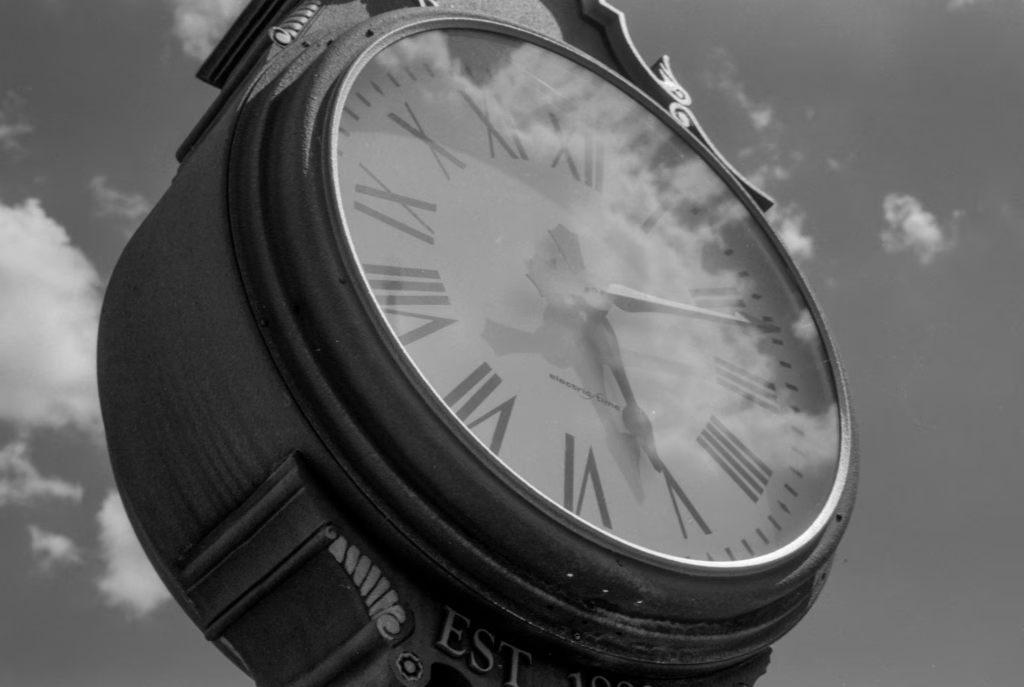
-
White Cane Day Disaster
Today, October 15th, marks White Cane Safety Day, a national observance in the United States that’s been celebrated annually since 1964. It’s more than just a date on the calendar; it’s a powerful reminder of the incredible contributions blind and visually impaired individuals have made to the world, from innovators like Louis Braille, who revolutionized reading for the blind, to countless artists, scientists, and leaders who’ve shaped society because of their unique perspectives. But it’s also a stark call to action for all of us, especially motorists. The white cane isn’t just a mobility tool, it’s a symbol of invisibility. It screams, “We can’t see—please see us.”
As someone who relies on that very cane every day, I set out this afternoon with a mix of pride and purpose, heading to the post office on what should have been a routine errand. White Cane Day always stirs a bit of optimism in me, a hope that awareness will bridge the gaps in understanding. But reality has a way of humbling us, doesn’t it? Let me share what happened, because these aren’t just stories, they’re the everyday truths that underscore why this day matters so much.
I approached the crosswalk near my neighborhood, cane tapping rhythmically against the pavement, ears tuned to the symphony of traffic and distant engines. That’s when it happened, an electric car glided up silently, like a ghost in the machine. I stepped into the crosswalk and suddenly, a sharp honk pierced the air. The driver had the nerve to blast their horn at me, as if I were the one at fault for not leaping out of their path. I didn’t hear the car approaching; those whisper-quiet EVs are a nightmare for anyone navigating by sound alone. My heart raced, but I stood my ground, cane firmly planted. Blind pedestrians always have the right of way, and moments like this? They’re a brutal reminder that not everyone knows or respects that rule.
Shaken but determined, I continued to the post office, weaving through the parking lot with careful sweeps of my cane. As I walked behind what I assumed was an empty pickup truck, listening for any signs of life, the engine cranked to life. The driver, a kind-hearted lady as it turned out, must’ve been in a rush. Before I could react, shout, or sidestep, she began backing up. Thud. A light bump against my side, enough to send a jolt through me but not enough to knock me down. I might have a bruise blooming on my hip tomorrow, but honestly, no big deal in the grand scheme. She apologized profusely and asked if I was okay. “I was looking right at my backup camera,” she explained, “but you were in its blind spot.” She promised to double-check her mirrors next time, and I could tell the encounter shook her more than it did me. It’s encounters like this that humanize the statistics, turning abstract awareness into real empathy.
These aren’t isolated incidents; they’re the threads in a larger tapestry of hesitation that keeps many blind people sidelined from the streets. No matter how rigorous our Orientation and Mobility (O&M) training is, learning to navigate intersections, gauge traffic flow, and trust our senses, there’s always the wildcard: distracted drivers, overlooked signals, and yes, those insidious electric cars that sneak up without a whisper. It’s why we pause at curbs a little longer, why we grip our canes a little tighter. White Cane Day shines a light on this, urging society to not just recognize our achievements but to actively make space for our safety.
So, on this October 15th, let’s lean into the day’s dual spirit. Celebrate the blind trailblazers who’ve enriched our world, from Helen Keller’s advocacy to modern tech wizards coding accessibility into our digital lives. And to every driver out there: Scan those blind spots, yield at crosswalks, and remember what that white cane means. See us. Hear us. Make room for us. Because in a world that’s increasingly quiet and fast, awareness isn’t optional, it’s essential.
If you’ve got your own White Cane Day stories or tips for safer streets, drop them in the comments below. Let’s build a more visible path together.
Stay safe out there.
-
Life’s Blind Illumination
If you’ve stumbled upon this little corner of the internet, thank you for being here. I’m just a guy who’s spent most of his life chasing light through a lens, and lately, that light has started to fade in ways I never quite imagined. This post isn’t meant to be a pity party or a grand manifesto, I’m no expert on resilience, just someone muddling through with a heart full of gratitude and a camera bag that’s gotten a bit lighter over the months. But writing has always been a quiet companion to my photography, a way to make sense of the frames I capture (or, these days, the ones I remember). So, with a deep breath and a humble nod to God, here’s where my story sits right now.
It started with a simple video. Yesterday, I hit record on my phone for Instagram, a raw, rambling clip from the heart about the sting of going blind and what that means for the photographs I’ve loved making. I poured out the ache of knowing I can’t nail those perfect compositions or exposures anymore, the kind that come from years of squinting at a scene with my one good eye and just knowing. Film has its own personality, doesn’t it? Fomapan with its moody shadows and tight latitude, Kentmere offering a bit more forgiveness in the highlights. Details like that live in my head, etched from decades of trial and error. But my eyes? They’ve decided to bow out early. Five doctors, the state of Arizona, and the U.S. government all agree: I’m beyond legally blind, teetering on the edge of total darkness. I wake up each morning bracing for the day it all goes black.
About two months back, the warning signs ramped up. Closing my eyes brought flashes of random colors and lights, like a faulty projector spinning out of control. That sliver of vision I had left, five degrees on a good day, turned blurry, turning the world into soft-edged blobs. I laughed it off in an article I wrote, calling everyone a “blob” because, well, humor’s been my shield against the heavy stuff. But reality doesn’t stay polite for long.
One afternoon, I picked up one of my trusty SLR film cameras, the kind that’s felt like an extension of my hand for years. I tried to focus. Couldn’t. The viewfinder swam into nonsense. Composition? Forget it—that narrow tunnel of sight wasn’t enough to frame a thought.
I found myself on a park bench that day, head in hands, weeping for what felt like hours. Self-pity wrapped around me like fog, thick and unyielding. It was the first time I’d let the full weight of it crash down. I haven’t lifted a camera to shoot since, not one single frame. In the haze of those weeks, I started selling off pieces of my collection, each transaction a quiet goodbye to the tools that shaped my world. All that’s left now are my beloved folding cameras, with their tactile folds and whispers of history, and two SLRs I just can’t part with. They’re like old friends I can’t bear to lose, even if they sit gathering dust.
Looking back, I’ve been dancing with this shadow for longer than I care to admit. As a kid, doctors warned I’d lose my sight in adolescence. It didn’t happen, praise God for that grace, and maybe that’s why I’ve poured everything into photography. Forty years as a hobbyist, twenty as a professional. Every click was a prayer, a moment stolen from time.
Through breakups and breakthroughs, lean years and laughter, that passion kept me steady. It wasn’t about fame or perfection; it was joy, pure and simple. Losing it? It’s like misplacing a limb. For months, I’ve wandered aimlessly, future a foggy outline. But I’m not alone in the drift, Jesus has been my anchor, my wife my soft place to land, and our three goofy pups? They’re the daily reminder that wagging tails don’t need perfect vision.
Yesterday morning, something shifted. I woke with a spark, not a wildfire, just a gentle glow. Determination, I suppose you’d call it. I dug into a folder of unreleased shots from a May trip, landscapes that still make my heart hum even if I can’t see them sharply anymore. I posted a few, tentative steps back into sharing. I didn’t head out to shoot, but the thought lingered, whispering maybe. The truth is, I hold myself to impossible standards, flawless light, impeccable lines that I wouldn’t dream of expecting from anyone else. It’s a humble brag wrapped in humility: I’ve been blessed with skill, but pride can be a sneaky thief. How do I create without chasing ghosts of what was?
This road to blindness? I wouldn’t wish it on my worst enemy. It’s lonely, riddled with “what ifs” that echo in the quiet hours. But here’s the quiet miracle: it led me to the blind center in Phoenix. Walking through those doors flipped the script. Suddenly, it wasn’t the end of my story but a pivot to a new chapter. I’ve met folks who get it, the raw grief, the stubborn spark. Some love photography as fiercely as I do, swapping tips on adaptive gear like it’s the most natural conversation. Together, we’ve sparked an advocacy group here in Arizona, a loose band of encouragers lifting each other up. No heroes among us, just people saying, “Hey, you’ve got this—one step at a time.”
Life’s gone tactile now, and there’s a strange beauty in that. Braille bumps under my fingers, keyboard clicks like Morse code for my thoughts. Cameras with dials and buttons? They’re gold, things I can map in my mind, muscle memory overriding the dark. Tomorrow, I’m pulling out my Minolta Maxxum, that autofocus wonder with its forgiving heart. I’ll give it a go, no pressure, just curiosity.
Scanning the negatives afterward will be a puzzle, details lost to me, but that’s the thrill, isn’t it? An adventure in trust, handing the reveal over to the machine and whatever magic it uncovers.
I love this part, if I’m honest, the relearning. Figuring out angles by sound and feel, composing by instinct honed over lifetimes. Lights? Who needs ’em? I navigate just fine in the pitch black, a skill that’s equal parts survival and secret superpower. It’s all a gift, wrapped in loss, reminding me that sight was never the whole picture.
If you’re reading this and facing your own storm—big or small—know this: it’s okay to sit on that bench for a while. But don’t stay there forever. Reach for the hand extended, whether it’s a friend’s, a stranger’s at a support group, or the steady one from above. I’m still figuring it out, one humble frame at a time. Life? It’s good. Messy, blurred at the edges, but profoundly good.
Thanks for letting me share. Drop a note if this resonates. I’m all ears (and heart). Until next time, keep chasing what lights you up, however dim the path.
With quiet thanks,
Jefferson Davis