-
Understanding ADA Compliance vs. Accessibility
When people talk about the Americans with Disabilities Act (ADA), they often assume that “compliant” automatically means “accessible.” It doesn’t. In fact, the gap between those two ideas is where many disabled people run into the most frustrating and sometimes dangerous experiences.
ADA compliance is about meeting the minimum legal requirements. It’s a checklist: Are there braille room signs? Are doorways wide enough? Is there a ramp?
ADA accessibility, on the other hand, is about whether a space is actually usable in the real world by people with disabilities. It’s not just “Did you install the sign?”, it’s “Does this space work for someone navigating it independently?”.
That distinction might sound subtle, but in practice, it’s enormous.
A Real Experience: When Compliance Falls Short
Recently, I had to visit Norman Regional Hospital with my wife. She was dealing with some health issues, thankfully, she’s doing better now, but during the day and a half I spent there, I encountered a pattern that perfectly illustrates the difference between compliance and true accessibility.
In case you found this post through search and don’t know me: I’m blind. I have about two degrees of peripheral vision left, but what I see is so diffused it’s essentially a blur.
Throughout my stay, I asked staff where I could find things like vending machines. Every time, someone kindly offered to bring me food or a drink instead. I appreciated the help, but that wasn’t the point. I wanted the ability to navigate independently, to explore the space like anyone else.
At one point, I was even asked not to leave the room. It was framed as concern for my safety. And I understand that instinct, but it raises an important question: why is the environment so difficult to navigate that independence is discouraged?
That’s not accessibility. That’s containment.
Where the Hospital Got It Right—and Wrong
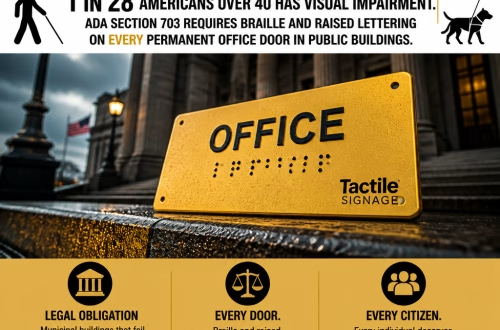
To be fair, the hospital did check some ADA boxes. There were braille signs on every room. That’s compliance.
But here’s where things broke down:
- There were no braille or raised-letter navigation signs to help someone move through hallways.
- The main entrance was massive and confusing, with no clear tactile or accessible guidance.
- I needed a family member to guide me back to my wife’s room after leaving the building.
- Worst of all, the braille on her room sign was wrong—off by one digit. I found another incorrect sign elsewhere.
This is the perfect example of compliance without usability. The signs existed, so technically a box may have been checked. But if the information is inaccurate or incomplete, it doesn’t just fail, it misleads.
That’s not accessibility. That’s a hazard.
Compliance Is the Floor, Not the Ceiling
The ADA, particularly through standards like ADA Title III and ADA Title II, lays out requirements for signage, navigation, and equal access. But laws can only go so far.
They define the minimum. They don’t guarantee a good experience.
True accessibility asks deeper questions:
- Can someone navigate the space without assistance?
- Is the information accurate and consistent?
- Are systems designed with real users in mind, not just regulations?
It’s Not Just Hospitals
A few days after my wife was discharged, we went to breakfast at Neighborhood Jam, one of her favorite spots because they offer gluten-free options.
After eating, I headed toward the restroom based on her directions.
And then I hit another wall: there were no restroom signs I could use.
No braille. No raised lettering. Just visual text on the door that I wouldn’t have known about had my wife not told me.
This is an area where ADA requirements are actually quite clear. Restrooms are supposed to be properly labeled. There have been lawsuits over exactly this issue. And yet, here we are.
What makes it more frustrating is how simple the fix is. A compliant braille sign can cost as little as $13. This isn’t a massive infrastructure overhaul. It’s a small, meaningful step that makes a space usable for more people.
The Bigger Picture
After we got home and my wife had time to rest from her hospital stay, I filed a complaint. I don’t know if anything will come of it, but staying silent guarantees nothing will change.
The truth is, most accessibility failures aren’t about bad intentions. The staff at the hospital were kind. The restaurant serves great food. But good intentions don’t replace good design.
And that’s the heart of the issue:
- Compliance says: “We followed the rules.”
- Accessibility says: “People can actually use this space.”
Until more organizations aim for the second, disabled people will continue to face unnecessary barriers—sometimes subtle, sometimes blatant, but always impactful.
Final Thought
Accessibility isn’t about going above and beyond, it’s about recognizing that independence matters. At the end of the day, the goal isn’t just to allow disabled people into a space. It’s to make sure they can move through it, understand it, and exist in it on our own terms.
-
Blob City
I’ve spent many sleepless nights trying to find the right words to describe what it’s like to go completely blind. It’s not like flipping off a light switch! For most people who are blind, about 90% according to the stats, there’s still something to see. Maybe it’s just light perception, like knowing the sun’s out there doing its thing, or maybe it’s catching a glimpse of colors, like a fuzzy rainbow. But for a few folks I know who’ve been completely blind since birth, sight is just one piece of the sensory puzzle, and they prove you can live a full, vibrant life without it. Me? I’m somewhere near the end, navigating a world of blobs, and let me tell you, it’s a wild ride.
Let’s get one thing straight: life without sight isn’t easy, but it’s absolutely worth living to the fullest. I mean, who needs 20/20 vision when you’ve got stubbornness, a good sense of humor, and a knack for dodging furniture? (I still bump into things, but I’m working on my ninja skills.) The world of blindness is filled with challenges, but it’s also brimming with possibilities. I love chatting with people about the tech that’s out there, like screen readers, smart canes, apps that describe the world like a chatty tour guide. But the real MVP in my life is Braille.
Braille is like the secret handshake of the blind community. It’s tactile, it’s elegant, and it keeps my brain as sharp as a tack. Fun fact: reading braille lights up the same part of your brain as reading with your eyes. So, while I’m running my fingers over those delightful dots, I’m basically doing mental push-ups. Without braille, I’m not sure I’d be as happy as I am today. It’s my bridge to a world of books, notes, and magazines.
I’ve been blind in one eye since I was a day old, thanks to a condition called Septo-Optic Dysplasia, which led to Optic Atrophy. Sounds like a villain from a sci-fi flick, right? Basically, it means my optic nerve cells are slowly checking out, like guests leaving a party early. Back in the 1970s, though, I didn’t let that stop me. I was just another kid, tearing around on bikes and motorcycles, channeling my inner Evel Knievel. Sure, I had more crashes than the average daredevil—my nickname was and still is “Crash”—but I didn’t care. My parents were my biggest cheerleaders, telling me I could do anything. I still believe them.
In January 2024, my doctor dropped a bombshell: “Stop driving.” The next month, another gut-punch: I had about two years of sight left. We hoped it’d stretch longer, but my vision had other plans. Right now, I’m down to five degrees of peripheral vision, and it’s blurry, like looking through a foggy window. Everyone and everything is a blob. My wife, Deana has been my rock through this whole journey, encouraging me to keep going, even when I’m tempted to throw a pity party for one.
Here’s what it’s like to live in Blob City. I can still pick up colors, so I might notice a red hat or a green shirt, but details? Forget it. Reading text is like trying to solve a puzzle in a windstorm. I have to stare at it forever, and it better be in font size “Billboard.” Walking, though, is my jam. It clears my head and usually puts me in a better mood. This morning, I strolled down to Green Valley Park, looped around the lake, and decided to grab Deana a drink from the gas station on the way back. Easy, right? Wrong.
I sauntered up to the cooler, ready to be the hero of hydration, only to remember I couldn’t read the labels. Picture me, squinting like a detective at a crime scene, trying to guess which bottle was Deana’s favorite. I grabbed one that looked vaguely familiar and hoped for the best. Then, a kind stranger piped up: “Need any help?” I could’ve hugged him. He confirmed I’d picked the right drink, then asked, “How’d you figure that out?” I explained my blob-vision situation, and he was surprised. Like most folks, he saw my white cane and dark glasses and assumed I was living in total darkness. Nope, just blob central.
That white cane and dark glasses? It’s like the unofficial “blind uniform.” People see it and assume I can’t see a thing, which is honestly a safe bet. I don’t mind the assumptions, better safe than sorry, right? Most people are just trying to help, and I’m grateful for it. I always say “thank you,” even if I don’t need the assistance. The other day, someone offered to guide me across the street, and I thought, Buddy, I’ve been crossing streets since disco was king. But I smiled, said thanks, and let them feel like a superhero. It’s a win-win.
The truth is, every blind person’s experience is different. Some of us see blobs, some see light, some see nothing at all. What we all share is the ability to adapt, to find joy in the little things, and to keep moving forward. For me, that means laughing at my own misadventures, like the multiple times I called a Mister a Misses or vice versa. That can get dicey really quick.
Losing my sight hasn’t been easy, but it’s taught me to lean into life’s unpredictability. I’m still the kid who rode motorcycles and dreamed big, just with a few more battle scars and a better sense of humor. With Deana by my side, braille to keep me sharp, and the occasional kind stranger to point me toward the right soda, I’m living a life that’s full, messy, and mine. So here’s to the blobs. May they always be colorful, and may I never stop finding the humor in this wild, blurry world.