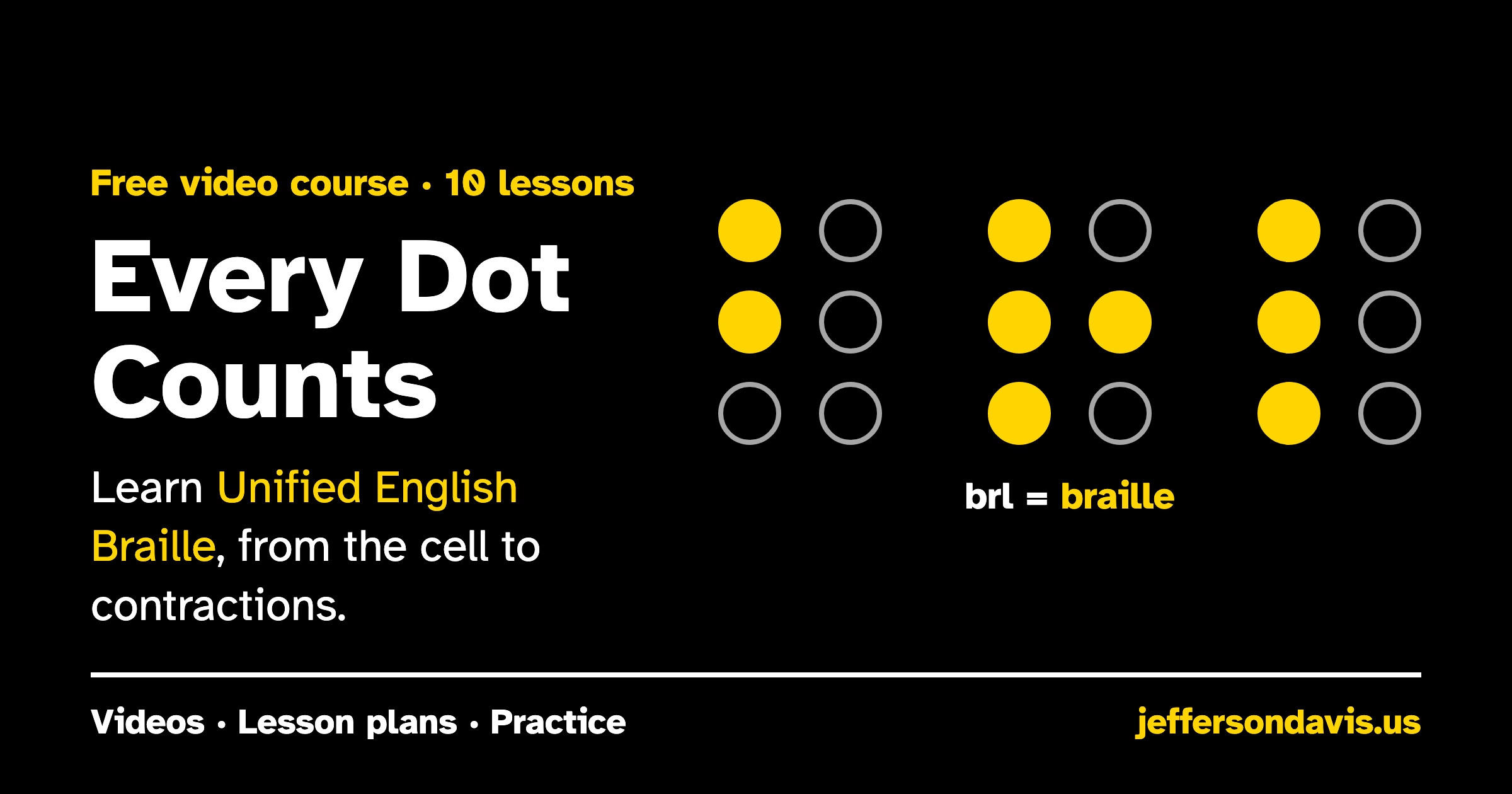
Every Dot Counts is a free course in Unified English Braille (UEB). Watch each video, then work through its lesson plan. Practice items show braille as Unicode cells (⠃⠗⠇), with dot numbers for screen reader users. Answers are hidden under each lesson. Work in order: every lesson builds on the one before it.
Lesson 0: The Braille Cell
You will learn to: name the six dot positions, describe any cell by its dot numbers, and explain why the cell allows 63 patterns.
Key ideas: A cell is two columns of three dots. The left column is dots 1, 2, 3 from top to bottom. The right column is dots 4, 5, 6. A full cell is ⠿ (dots 1-2-3-4-5-6). Every letter, number and sign is one cell or a short group of cells. Read with the pads of your fingers using a light touch, and keep both hands on the line.
Try this: Use an egg carton cut to six cups, or a muffin tin, as a giant cell. Drop a coin in each cup as you say its number.
Practice: Name the dots in each cell.
- ⠁
- ⠃
- ⠉
- ⠇
- ⠸
- How many dot patterns can one cell make, not counting a blank cell?
Answers
1. Dot 1. 2. Dots 1-2. 3. Dots 1-4. 4. Dots 1-2-3. 5. Dots 4-5-6. 6. Sixty-three.
Lesson 1: The Alphabet, A to Z
You will learn to: read and write all 26 letters by memorizing just ten and applying two rules.
Key ideas: Letters a to j use only the top four dots: ⠁⠃⠉⠙⠑⠋⠛⠓⠊⠚. Rule one: add dot 3 to a through j to get k through t: ⠅⠇⠍⠝⠕⠏⠟⠗⠎⠞. Rule two: add dots 3 and 6 to a through e to get u, v, x, y, z: ⠥⠧⠭⠽⠵. The one exception is w (⠺, dots 2-4-5-6), because the French alphabet Louis Braille worked from had no w.
Practice: Read items 1 to 4. Write items 5 and 6.
- ⠉⠁⠃
- ⠙⠕⠛
- ⠋⠊⠭
- ⠵⠑⠗⠕
- wax
- jump
Answers
1. cab. 2. dog. 3. fix. 4. zero. 5. ⠺⠁⠭. 6. ⠚⠥⠍⠏.
Lesson 2: Capital Letters
You will learn to: mark a capital letter, a capitalized word, and a capitalized passage.
Key ideas: Braille has no separate capital shapes. Dot 6 (⠠) before a letter makes it a capital. Two dot 6 cells (⠠⠠) capitalize a whole word. Three (⠠⠠⠠) start a capitalized passage of three or more words, and the capitals terminator ⠠⠄ ends it.
Practice: Read items 1 to 3. Write items 4 and 5.
- ⠠⠁⠝⠝
- ⠠⠠⠝⠁⠎⠁
- ⠠⠃⠕⠃
- Max
- OK
Answers
1. Ann. 2. NASA. 3. Bob. 4. ⠠⠍⠁⠭. 5. ⠠⠠⠕⠅.
Lesson 3: Numbers
You will learn to: read and write numbers with the numeric indicator, including commas and decimals.
Key ideas: The numeric indicator ⠼ (dots 3-4-5-6) turns the letters a to j into the digits 1 to 0. One indicator covers every digit that follows. A comma inside a number is dot 2 (⠂) and a decimal point is dots 2-5-6 (⠲); neither ends the number. A space ends numeric mode. If a letter a to j comes right after a number, put the grade 1 indicator ⠰ (dots 5-6) before it so it is not read as a digit.
Practice: Read items 1 to 4. Write items 5 to 7.
- ⠼⠁⠃
- ⠼⠃⠚⠃⠋
- ⠼⠁⠂⠚⠚⠚
- ⠼⠉⠲⠁⠙
- 7
- 45
- 3a
Answers
1. 12. 2. 2026. 3. 1,000. 4. 3.14. 5. ⠼⠛. 6. ⠼⠙⠑. 7. ⠼⠉⠰⠁.
Lesson 4: Punctuation
You will learn to: read and write the common punctuation marks and tell apart signs that share a shape.
Key signs: period ⠲ (2-5-6), comma ⠂ (2), question mark ⠦ (2-3-6), exclamation mark ⠖ (2-3-5), apostrophe ⠄ (3), hyphen ⠤ (3-6), colon ⠒ (2-5), semicolon ⠆ (2-3), opening quotation mark ⠦ (2-3-6), closing quotation mark ⠴ (3-5-6). Most punctuation sits in the lower part of the cell. The question mark and the opening quote share one shape; position tells you which it is. Before a word it opens a quote; after a word it asks a question.
Practice: Read items 1 to 4. Write items 5 and 6.
- ⠠⠓⠊⠲
- ⠠⠓⠑⠇⠏⠖
- ⠠⠽⠑⠎⠦
- ⠠⠃⠕⠃⠄⠎
- Hi, Ann.
- “Hi!”
Answers
1. Hi. 2. Help! 3. Yes? 4. Bob’s. 5. ⠠⠓⠊⠂ ⠠⠁⠝⠝⠲. 6. ⠦⠠⠓⠊⠖⠴.
Lesson 5: Alphabetic Wordsigns
You will learn to: use the 23 one-letter words of contracted braille and apply the standing-alone rule.
Key signs: b but, c can, d do, e every, f from, g go, h have, j just, k knowledge, l like, m more, n not, p people, q quite, r rather, s so, t that, u us, v very, w will, x it, y you, z as. A, I and O are left out because they are already words. Standing-alone rule: a letter means its word only when it stands alone, with spaces or punctuation around it. The b in “butter” is just the letter b.
Practice: Read items 1 to 3. Write item 4. Answer item 5.
- ⠽ ⠉ ⠛⠲
- ⠠⠊ ⠇ ⠏⠲
- ⠠⠙ ⠽ ⠇ ⠭⠦
- It is not so.
- Why is “a” not a wordsign?
Answers
1. you can go. 2. I like people. 3. Do you like it? 4. ⠠⠭ ⠊⠎ ⠝ ⠎⠲ 5. The letter a standing alone already is the word “a.”
Lesson 6: Shortforms
You will learn to: recognize shortforms, the abbreviated spellings of common words.
Key signs: A shortform drops letters but keeps enough to guess the word. braille = brl (⠃⠗⠇), about = ab, after = af, again = ag, also = al, because = bec, could = cd, friend = fr, good = gd, letter = lr, little = ll, much = mch, necessary = nec, today = td, tomorrow = tm, tonight = tn, your = yr. Most take common endings such as s: friends = ⠋⠗⠎. Learn them in groups by pattern: first two letters (ab, af, ag), first and last letters (cd, gd), and the to- words (td, tm, tn).
Practice: Read items 1 to 4. Write items 5 to 7.
- ⠁⠃
- ⠋⠗⠎
- ⠞⠙
- ⠠⠛⠙ ⠋⠗⠎ ⠗⠂⠙ ⠃⠗⠇⠲
- because
- little
- again
Answers
1. about. 2. friends. 3. today. 4. Good friends read braille. (⠂ in “read” is the ea sign from Lesson 7.) 5. ⠃⠑⠉. 6. ⠇⠇. 7. ⠁⠛.
Lesson 7: Strong and Lower Contractions
You will learn to: use one-cell signs for common words and letter groups, and know where lower signs may go.
Strong contractions: and ⠯, for ⠿, of ⠷, the ⠮, with ⠾. They can join with no space between them: “and the” is ⠯⠮. Strong groupsigns: ch ⠡, gh ⠣, sh ⠩, th ⠹, wh ⠱, ed ⠫, er ⠻, ou ⠳, ow ⠪, st ⠌, ar ⠜, ing ⠬. Standing alone, ch is child, sh shall, th this, wh which, ou out, st still. Lower signs use only dots 2, 3, 5, 6: ea ⠂, bb ⠆, cc ⠒, ff ⠖, gg ⠶, en ⠢, in ⠔. Standing alone, ⠆ is be, ⠶ were, ⠦ his, ⠴ was, ⠢ enough, ⠔ in. Ea, bb, cc, ff and gg are used only in the middle of a word.
Practice: Read items 1 to 4. Write items 5 to 8.
- ⠮ ⠉⠁⠞
- ⠩⠊⠏
- ⠌⠕⠏
- ⠉⠕⠖⠑⠑
- with the
- thing
- shout
- butter
Answers
1. the cat. 2. ship. 3. stop. 4. coffee. 5. ⠾⠮. 6. ⠹⠬. 7. ⠩⠳⠞. 8. ⠃⠥⠞⠞⠻.
Lesson 8: Initial-Letter Contractions
You will learn to: read two-cell words made from a prefix cell plus the word’s first letter.
Key signs: Dot 5 (⠐): day ⠐⠙, ever ⠐⠑, father ⠐⠋, here ⠐⠓, know ⠐⠅, mother ⠐⠍, name ⠐⠝, one ⠐⠕, part ⠐⠏, question ⠐⠟, right ⠐⠗, some ⠐⠎, time ⠐⠞, under ⠐⠥, work ⠐⠺, young ⠐⠽, there ⠐⠮, through ⠐⠹, where ⠐⠱. Dots 4-5 (⠘): upon ⠘⠥, word ⠘⠺, these ⠘⠮, those ⠘⠹, whose ⠘⠱. Dots 4-5-6 (⠸): cannot ⠸⠉, had ⠸⠓, many ⠸⠍, spirit ⠸⠎, world ⠸⠺, their ⠸⠮. Unlike wordsigns, these also work inside longer words: someone is ⠐⠎⠐⠕.
Practice: Read items 1 to 5. Write items 6 to 8.
- ⠐⠞
- ⠐⠍
- ⠘⠺
- ⠸⠺
- ⠐⠎⠐⠕
- day
- upon
- many
Answers
1. time. 2. mother. 3. word. 4. world. 5. someone. 6. ⠐⠙. 7. ⠘⠥. 8. ⠸⠍.
Lesson 9: Typeforms (Italic, Bold, Underline)
You will learn to: show italic, bold, underline and script for a letter, a word or a passage.
Key ideas: Each typeform has a prefix: italic ⠨ (4-6), bold ⠘ (4-5), underline ⠸ (4-5-6), script ⠈ (4). Add a second cell for how much it covers: ⠆ (2-3) one symbol, ⠂ (2) one word, ⠶ (2-3-5-6) a passage, ⠄ (3) the terminator that ends it. So ⠨⠂ is italic word and ⠘⠶ starts a bold passage. A typeform indicator comes before a capital indicator.
Practice: Read items 1 and 2. Write items 3 to 5.
- ⠨⠂⠝
- ⠘⠂⠌⠕⠏
- The word “free” in bold
- The letter a underlined
- The indicators that start and end an italic passage
Answers
1. not (italic). 2. stop (bold). 3. ⠘⠂⠋⠗⠑⠑. 4. ⠸⠆⠁. 5. ⠨⠶ to start, ⠨⠄ to end.
Next up: Every Dot Counts: Contracted, a deeper series on UEB Grade 2. Subscribe on YouTube so you don’t miss it.