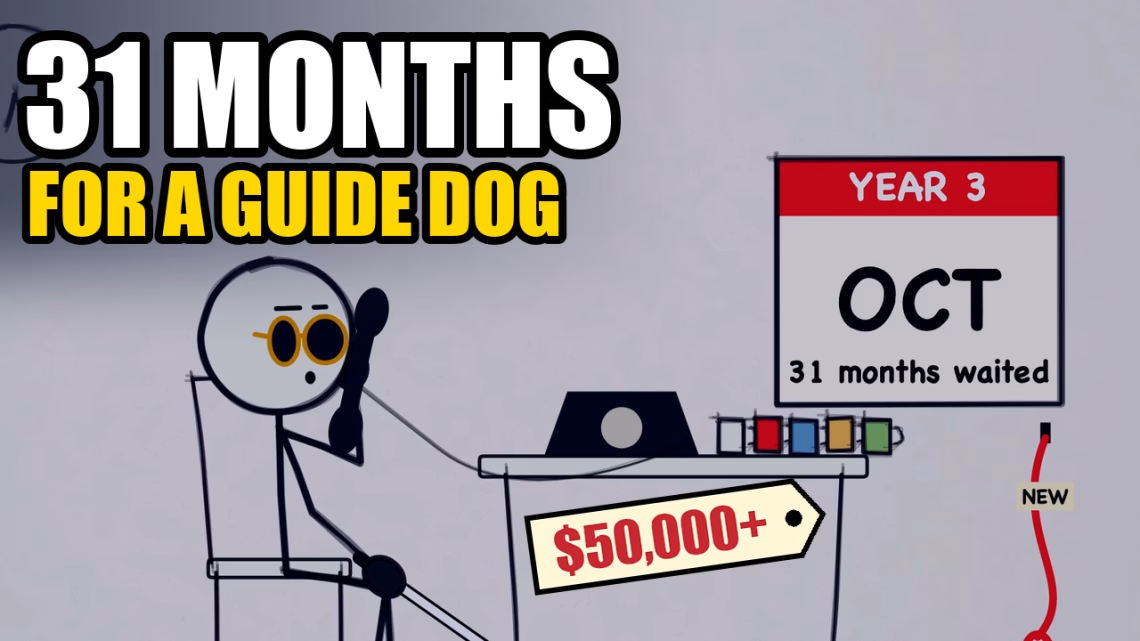
Waiting for a Guide Dog: The Wait, the Cost, the Training
Conor applied for a guide dog in March. He filled out the application, turned in a medical report, got through an orientation and mobility evaluation, did a phone interview, and had someone come look at his house. Then he sat down next to the phone.
Conor is the stick figure in my animated series, and this new episode is called “The Wait.” It runs about a minute and a half. You can watch it here:
Nobody tells you what a strange thing it is to wait for that call. There is no delivery date. In the film, Conor picks up the receiver now and then to make sure the dial tone still works, because what if the phone broke and the school has been trying to reach him for a week? The coffee mugs pile up on the table. A plant on the windowsill keeps growing. There’s a red bowl on the floor with DOG written on it and a brand new leash on a hook, and neither one has been used. When the phone finally rings he nearly knocks everything over, and it’s somebody who wants to talk about extending his home warranty.
I wrote that joke because it hurts a little. Every call might be the call, so you answer every call. You think twice about the shower. You plan a trip and wonder if you should. You can’t really get on with your life, and you can’t really stop getting on with it either.
Waiting for a guide dog puts your entire life on hold. I’ve been waiting since March of 2025, a year and a half at this point. I understand why they have to wait for a guide dog that fits me. Even though I understand the reasons, it doesn’t help the wait. It’s hard to organize life without knowing all the pieces. Guide Dogs of the Desert has two classes a year, one in the Spring and one in the Fall. They only have 10 to 12 students a year. How can you possibly keep up with demand. You can’t. When the time comes for calls to go out from the schools, we wait and don’t sleep. My life is in a constant state of flux.
How long does it take? That depends on the school, the year, and the dog, and I can’t give you a single number. Pilot Dogs says its average wait for accepted students is more than 18 months. The Seeing Eye says only that wait time “is contingent on a number of factors”, because a class date depends on having the right dog for you, and an open seat isn’t enough. Outside the United States, blind people in New Zealand reported waits of up to three years in 2021. Conor waited two years and seven months. Some people wait less; some wait longer. Nobody gets to know in advance, and that’s the part that wears on you.
The dogs are slow to arrive because they are slow to make. At Guiding Eyes for the Blind, volunteers take a puppy home at about 8 weeks old and give it back at 16 to 18 months. After a year and more of learning house manners and getting used to the world, the dog spends roughly five months with a professional instructor. The Seeing Eye runs a four-month course after its own puppy raising. And not every dog makes it to the end; some turn out to be suited for a different career or none at all, and they get adopted out to a family.
Near the end of that training, a guide dog learns something I find remarkable. It’s called intelligent disobedience. If I tell my dog to go forward and a car is coming, the dog is supposed to refuse. Think about what you’re asking of that animal: years of learning to do what it’s told, and then the judgment to know when not to.
People are surprised when I tell them a guide dog gets more training than a police K9, so I went looking for numbers. Here is one comparison. Oakland Community College in Michigan runs a patrol dog academy where the dog gets one month of pre-service work, then a five-week course with its handler, then four days of acclimation training. Put that next to a year and a half in a puppy raiser’s home and five months in harness. I’ll be fair to the police dogs here. Other K9 courses run longer, those dogs arrive already partly trained, and they keep training for as long as they work. I couldn’t find anyone who has counted the hours for both kinds of dog side by side. The time it takes to get a guide dog ready for its first day on the job is still far longer than that academy, and I’ll stand by that.
All of this costs a great deal. Guiding Eyes puts it at $50,000 to raise and train a guide dog. The Guide Dog Foundation says $50,000 to breed, raise, train, and place one dog. The Seeing Eye says the full cost of a partnership, from breeding a puppy through placement, is roughly $75,000.
The blind person doesn’t pay that. Guiding Eyes says all of its services are free of charge, and it runs on donations. The Guide Dog Foundation also serves people at no cost. The Seeing Eye charges $150 for a first dog, $50 for each one after, and $1 for military veterans, the same nominal fee since the 1930s. Donors pick up the rest of the bill.
When each dog costs that much, there are never enough of them. A supporter page on the Guiding Eyes site estimates about 10,000 working guide dog teams in the United States, and says only about two percent of the blind population works with one. A 2025 commentary in The Philadelphia Inquirer says five percent. I couldn’t find a study behind either number, so take them as rough estimates. Not every blind person wants a dog or can work with one, either. Even so, the people who do want one are sitting by a phone.
I stopped the film on the phone call, and you never see Conor’s dog. The school calls, his hand shakes on the receiver, and it cuts to black. I wanted you to sit in the waiting for a minute, since the people living it don’t get to skip to the end.
If you can give, these are the six schools listed at the end of the film. More donations mean more dogs and shorter waits.
- The Seeing Eye
- Leader Dogs for the Blind
- Guiding Eyes for the Blind
- Guide Dogs of the Desert
- Guide Dogs for the Blind
- Guide Dog Foundation for the Blind
Discover more from Jefferson Davis — Blind Photographer, Advocate, Writer
Subscribe to get the latest posts sent to your email.

You May Also Like
Every Dot Counts: Contracted Braille (UEB Grade 2) Explained
Monday Jaunts Through Norman: Coffee, Chaos, and the Senses That Guide Me
